NVIDIA & Microsoft Reinvent the Windows PC for Personal AI Agents
RTX Spark delivers 1 petaflop, 128GB unified memory, native OpenShell agent security, Adobe rearchitected from scratch, 120B local LLMs, and 1440p gaming — all on a 14mm slim laptop. Here's every verified fact from the GTC Taipei announcement.
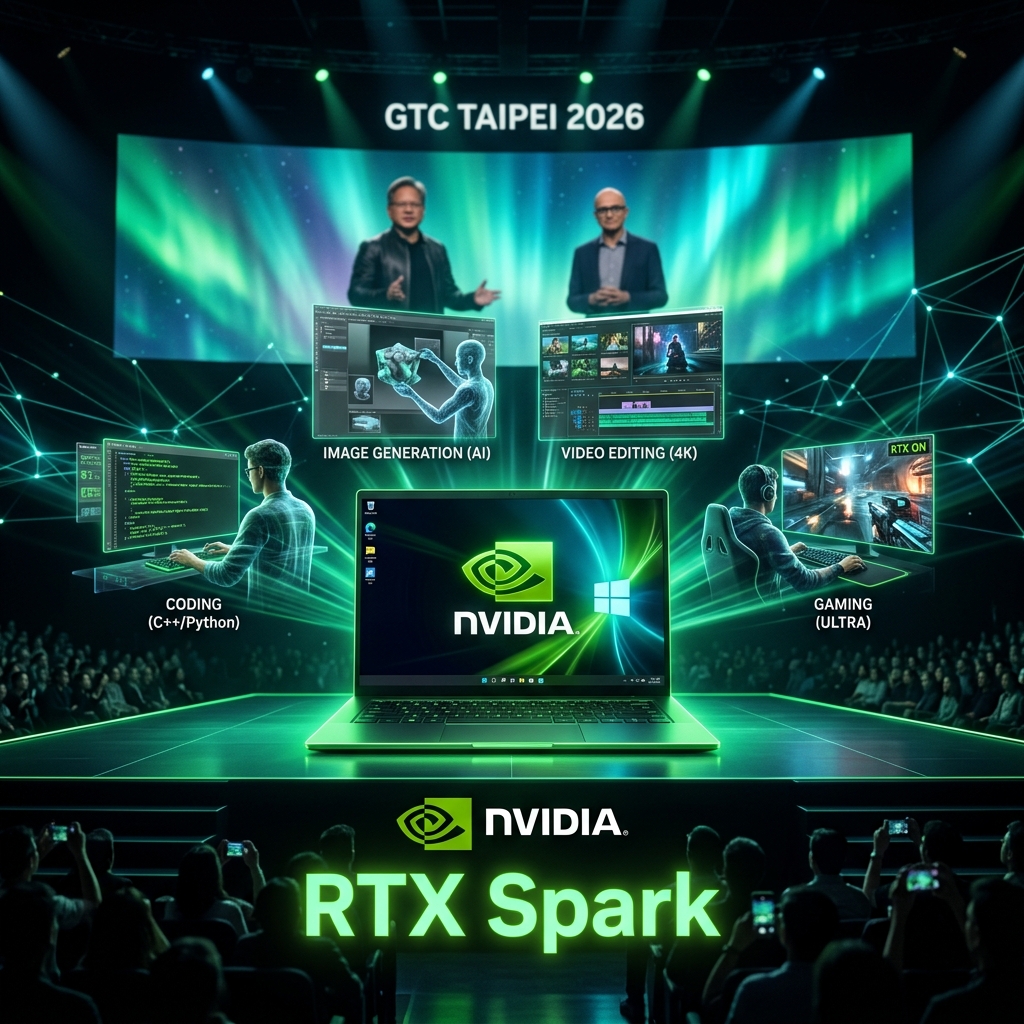
“For forty years, you launched apps. Click. Type. With RTX Spark and Microsoft Windows, you ask — and the PC does the work.” — Jensen Huang, NVIDIA CEO
The PC is being reinvented. Not with a faster processor. Not with a thinner chassis. With a fundamentally new purpose: your AI teammate.
At NVIDIA GTC Taipei, Jensen Huang took the stage with Satya Nadella and made one of the boldest PC announcements in a decade. The NVIDIA RTX Sparksuperchip — co-developed with MediaTek, designed for Windows, and backed by every major PC maker — isn't just a hardware upgrade. It's a platform shift that fuses 30 years of NVIDIA's AI and graphics technology into a chip slim enough to power a 14mm laptop.
The claims are extraordinary: 1 petaflop of AI compute, 128GB unified memory, the ability to run 120-billion-parameter LLMs locally, render 90GB 3D scenes, edit 12K video, and play AAA games at 1440p over 100fps— all in a single device. Let's fact-check every major claim and explain what it means for US consumers, developers, and creators.
📋 Fact-Check Sources: All technical specs and partner claims verified against NVIDIA's official GTC Taipei press release, NVIDIA RTX Spark product page, and The Verge's GTC Taipei coverage.
01.The RTX Spark Superchip: What's Inside
RTX Spark is not just a GPU. NVIDIA's official technical documentation describes it as a superchip — a full System-on-a-Chip that combines two distinct dies connected by the NVIDIA NVLink-C2Cchip-to-chip interconnect (the same high-bandwidth link used in NVIDIA's data center Grace Hopper platform):
“1 petaflop of AI compute” — accurate at FP4 precision
Confirmed via NVIDIA's RTX Spark product page. FP4 (4-bit floating point) is the precision mode used for AI inference — which is the relevant metric for running agents and LLMs, not the FP32 used in gaming benchmarks.
MediaTek co-designed the custom CPU — confirmed by both companies
NVIDIA's press release explicitly states: “MediaTek, a market leader in Arm-based system-on-a-chip designs, collaborated with NVIDIA on the custom CPU design.” This is a first for NVIDIA — partnering with MediaTek for consumer PC silicon. Coverage confirmed by AnandTech's chip analysis.
120B LLM with 1 million token context — verified NVIDIA spec
Explicitly stated in the official press release and confirmed by Georgi Gerganov (llama.cpp founder)who directly commented: “Highly optimized models running locally through llama.cpp with RTX Spark's AI performance will unleash the next wave of personal, private agents.”
02.OpenShell & Windows Security: Agents You Can Actually Trust
The hardest unsolved problem in consumer AI agents has never been capability — it's been trust. Can you give an AI agent access to your email, files, and browser without it leaking your data to a cloud server? NVIDIA and Microsoft are tackling this with a two-layer security architecture announced at GTC Taipei.
🛡️ Windows Security Primitives (Microsoft)
New OS-level capabilities including identity verification, containment, policy enforcement, and end-to-end encryption for agent tasks. Agents run in sandboxed environments — they cannot access resources outside their granted scope without explicit user approval. Announced at Microsoft Build 2026.
🔒 NVIDIA OpenShell Runtime
User-facing policy layer: define what agents can and cannot do, route sensitive queries to local models instead of cloud APIs, and optionally strip or anonymize personal information before any cloud request is made. OpenClaw and Hermes Agent have adopted OpenShell for their native Windows apps.
The implications are significant for US users who handle sensitive data. A lawyer using an RTX Spark laptop could run a 70B-parameter legal reasoning agent entirely on-device — no client data ever leaves the machine. A healthcare professional could use a multimodal agent to analyze patient records and images locally. As we covered in our deep-dive on Google's Gemma 4 12B encoder-free local model, the era of privacy-first local AI is accelerating fast — and RTX Spark is the most powerful hardware platform for it yet.
“Running solutions like OpenShell and the Microsoft security primitives on RTX Spark will enable users to leverage a fully integrated stack for private, personal agents running on device.”— Vincent Koc, Chief Architect, OpenClaw Foundation
📋 Fact-Check Source: OpenShell runtime and Windows security primitives confirmed via NVIDIA's official press release and Microsoft's Windows developer blog on agent security primitives.
03.Adobe Rearchitects Photoshop & Premiere — 2x Faster on RTX Spark
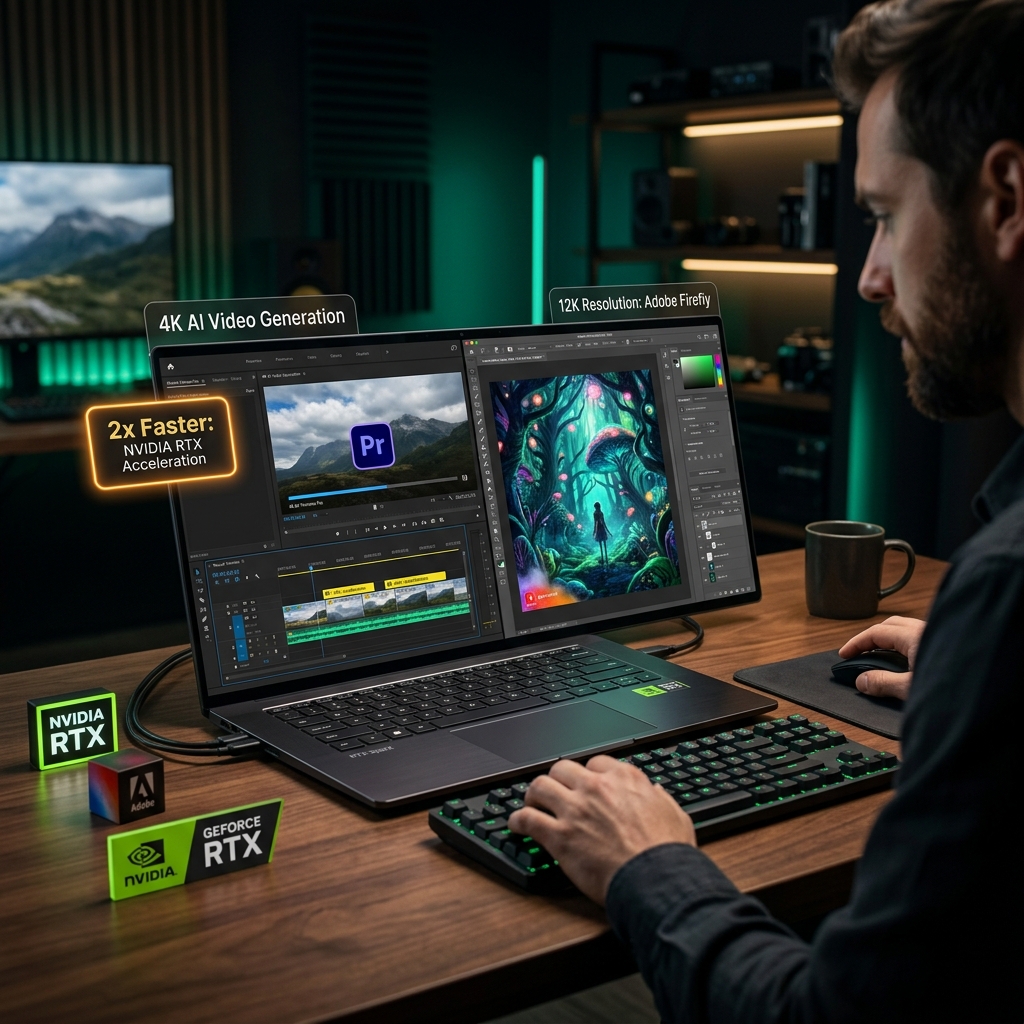
The most consequential partnership announced at GTC Taipei for US creative professionals is the NVIDIA-Adobe collaboration. This isn't incremental optimization — Adobe is rearchitecting Photoshop and Premiere Pro from the ground up for RTX Spark.
Adobe RTX Spark Enhancements — Verified Features
| App | New Capability | Performance |
|---|---|---|
| Premiere Pro | New video pipeline — real-time 12K 4:2:2 editing via unified memory + TensorRT | Real-time, GPU-accelerated |
| Premiere Pro | Firefly Generative Extend — AI-powered video length extension | 2x faster AI generation |
| Photoshop | Next-gen GPU-accelerated compositing engine with live filters and HDR | AI-native pipeline |
| Photoshop | Firefly Generative Fill — AI image generation and inpainting | 2x faster inference |
| Substance 3D Painter | Runs natively on RTX Spark for 3D texturing workflows | Smoother, more responsive |
| Substance 3D Stager | Native RTX Spark support for 3D scene creation | Native performance |
“Together, we are building AI-native creative experiences for RTX Spark that deliver the performance, intelligence and responsiveness people need to create at the pace of their ambition.”— Shantanu Narayen, Chair & CEO, Adobe
Adobe also confirmed that Premiere and Photoshop will be extended to allow Windows agent integration— meaning an AI agent could assist creators directly inside their Adobe workflow, automating repetitive editing tasks, generating assets on demand, and reasoning across a full project timeline. Updates are expected to roll out “alongside RTX Spark availability” — i.e., fall 2026.
📋 Fact-Check Source: All Adobe feature details verified against NVIDIA's press release and Adobe's official RTX Spark integration documentation.
04.Gaming & Local LLMs: One Chip, Two Extreme Workloads
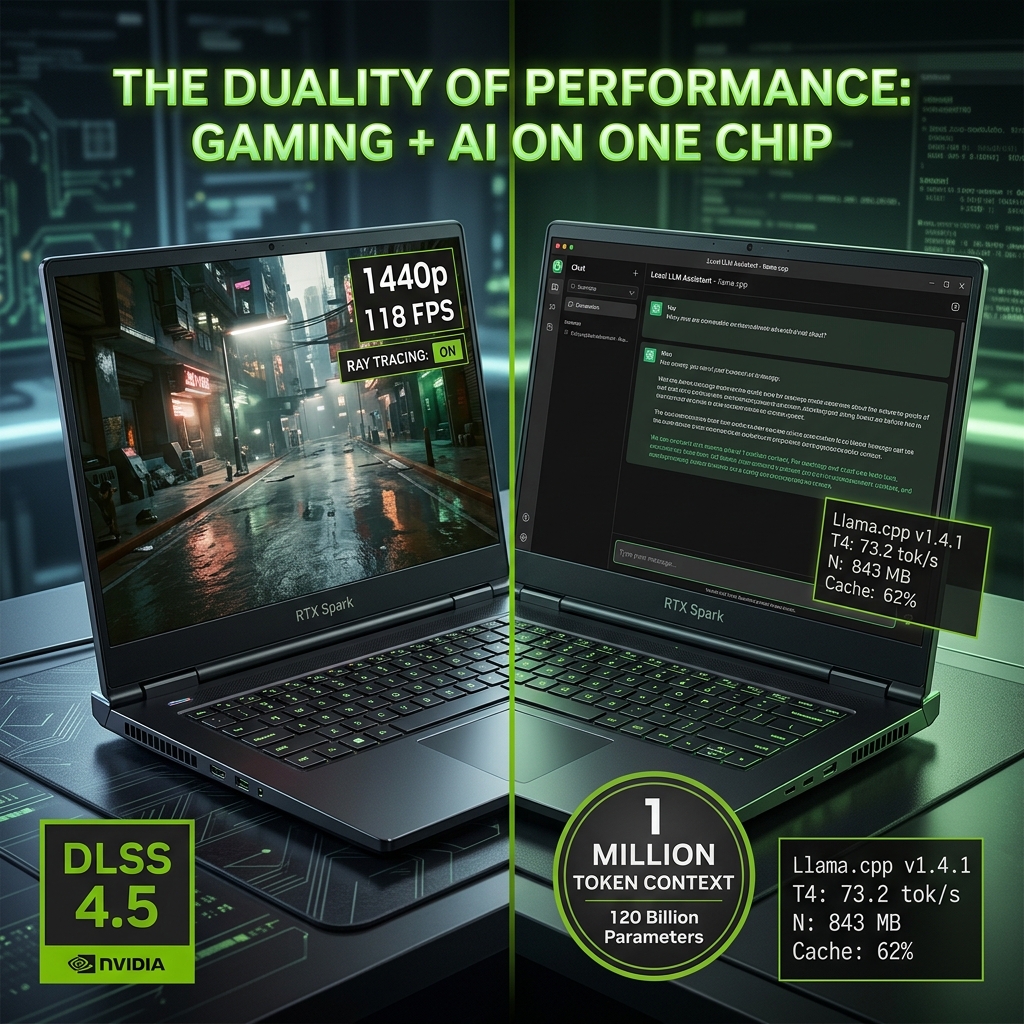
What makes RTX Spark uniquely compelling for the US consumer market is that it doesn't ask you to choose between a gaming PC and an AI workstation. The same Blackwell GPU that runs local 120B-parameter LLMs is also capable of AAA gaming at 1440p above 100fps with ray tracing.
🎮 Gaming Capabilities
- ✅ 1440p resolution, 100+ FPS in AAA titles
- ✅ Ray tracing enabled via Blackwell GPU
- ✅ DLSS 4.5 with 2nd-gen transformer Ray Reconstruction
- ✅ G-SYNC on tandem OLED display
- ✅ 1,000+ supported RTX games and apps
- ✅ KRAFTON, NetEase, Riot, Remedy, Xbox confirmed
🤖 Local AI Capabilities
- ✅ 120B-parameter LLMs via llama.cpp, vLLM
- ✅ 1 million token context window
- ✅ 4K AI video generation (ComfyUI)
- ✅ 90GB+ 3D scene rendering (OptiX + DLSS)
- ✅ 12K 4:2:2 video editing (Blackwell decoder)
- ✅ RTX Video 4x Frame Generation in ComfyUI
For US developers who currently maintain separate machines for AI workloads and personal use, RTX Spark's unified design eliminates that compromise. As we noted in our comparison of the best AI coding tools of 2026, the shift toward local-first AI development is accelerating — and having 128GB of unified memory available for both coding agents and creative workflows on a single laptop is a genuine workflow transformation.
05. Every PC Maker, Every CEO, Every Quote — Verified
What distinguishes RTX Spark from previous niche AI PC announcements is the breadth of its ecosystem commitment. This is not a single-OEM experiment. Every major Windows PC manufacturer is building RTX Spark hardware:
“With RTX Spark, ASUS has the platform to build systems that define the future of personal computing.”
“With RTX Spark, Dell is delivering RTX performance and massive unified memory in the XPS 16 Creator Edition.”
“One of the thinnest RTX Spark laptops, combining NVIDIA's RTX performance with unprecedented portable power.”
“We are delivering a whole new level of AI experiences to creators, gamers and AI developers together.”
“Surface Laptop Ultra is built for the way ambitious work gets done.”
“RTX Spark has enabled MSI to redefine what a compact, efficient PC can deliver.”
Acer and GIGABYTE are also confirmed as second-wave partners. On the software side, 100+ Windows software providers including Adobe, Blackmagic Design, Blender, CapCut, ComfyUI, and OTOY are embracing RTX Spark — with game developers KRAFTON, NetEase, Remedy Entertainment, Riot Games, and Xbox explicitly named.
06.What RTX Spark Means for US Consumers, Developers & Creators
For most Americans considering a laptop purchase in fall 2026, RTX Spark changes the calculus in three distinct ways depending on how you use your machine:
💻 Developers & AI Researchers
The 128GB unified memory pool is the first consumer platform capable of running production-grade 70B–120B models locally — eliminating $500–$2,000/month in API costs for researchers who need large context windows. The llama.cpp and vLLM integrations are day-one ready.
🎨 Creative Professionals
The Adobe partnership alone justifies the upgrade for Premiere and Photoshop power users. 2x faster Firefly AI + real-time 12K editing + GPU-accelerated compositing on a 14mm laptop is a meaningful workflow transformation. The addition of Windows agent support inside Adobe apps is a productivity multiplier that no current laptop offers.
🎮 Gamers Who Also Work
A laptop that delivers 1440p 100+ FPS AAA gaming AND runs a local coding/writing agent is a genuine first. You no longer need a gaming desktop for gaming and a MacBook for AI work. The unified memory architecture means you can switch between workloads without rebooting or reconfiguring.
The open question remains price. The comparable NVIDIA DGX Spark (a desktop-class version of this chip platform for developers) starts at $4,800. If RTX Spark laptops land in the $2,500–$4,000 range, they'll be premium-but-attainable for US professionals. If pricing pushes past $5,000, adoption will be limited to power users — at least for the first generation. For perspective on where personal AI hardware is heading, read our analysis of Google's Gemma 4 12B running on just 16GB VRAM — a complementary trend showing the software side catching up with the hardware.
⚡TechVantage Verdict
RTX Spark is the most significant Windows PC platform announcement since the original Surface — and unlike Surface, it has the ecosystem, the software partnerships, and the technical substance to succeed. The combination of NVIDIA's 30-year software stack (CUDA, DLSS, TensorRT, OptiX), a purpose-built unified memory architecture, Microsoft's OS-level agent security, and an Adobe partnership that restructures the world's most-used creative apps is a genuinely compelling story. Fall 2026 pricing will determine whether this is a professional tool or a mass-market revolution.
Follow every RTX Spark development in our Hardware category and AI category.
Topics
💡Frequently Asked Questions
What is NVIDIA RTX Spark and what makes it different from regular laptop GPUs?
RTX Spark is a superchip — a single chip that fuses a 20-core NVIDIA Grace ARM CPU (co-developed with MediaTek) and a Blackwell RTX GPU with 6,144 CUDA cores via the NVLink-C2C interconnect. Unlike discrete laptop GPUs, the CPU and GPU share up to 128GB of unified memory, which is the key that enables running 120-billion-parameter local LLMs. Regular laptops with discrete GPUs are limited by the GPU's own VRAM (typically 8–16GB).
Which PC brands are building RTX Spark laptops and when can I buy one?
ASUS, Dell (XPS 16 Creator Edition), HP (OmniBook), Lenovo, Microsoft (Surface Laptop Ultra), and MSI are confirmed first-wave launch partners. Acer and GIGABYTE will follow in a second wave. All RTX Spark laptops and compact desktops are targeted for fall 2026 availability. Pricing has not been officially announced, but industry estimates suggest starting prices between $2,500–$4,000 for laptops.
What is NVIDIA OpenShell and why does it matter for AI agents?
NVIDIA OpenShell is a runtime security layer specifically designed for on-device AI agents. It gives users policy controls over what agents can and cannot access, intelligently routes sensitive queries to local models (keeping data off the cloud), and can anonymize personal information before any data is sent to cloud APIs. It works alongside new Windows security primitives from Microsoft to create a sandboxed, privacy-preserving environment for agents like OpenClaw and Hermes Agent.
How does Adobe's RTX Spark integration work — what gets 2x faster?
NVIDIA and Adobe are rearchitecting Premiere Pro and Photoshop from the ground up for RTX Spark. In Premiere, a new video pipeline taps RTX Spark's unified memory, Blackwell GPU, and TensorRT for real-time 12K 4:2:2 editing and GPU-accelerated AI performance. In Photoshop, the next-generation engine enables GPU-accelerated compositing, live filters, high dynamic range, and modern brushing. Adobe Firefly-powered Generative Fill in Photoshop and Generative Extend in Premiere see 2x faster AI performance. Updates are expected to roll out alongside RTX Spark device availability in fall 2026.
Can RTX Spark really run a 120-billion-parameter LLM locally?
Yes — this is a verified NVIDIA specification. The 128GB unified memory pool is the enabling factor. Most consumer GPUs max out at 16–24GB of VRAM, which limits local LLMs to 7B–14B parameter models. At 128GB, a 120B model in Q4 quantization (roughly 60–70GB) fits comfortably, with room left for system overhead and context. The 1-petaflop FP4 AI compute ensures usable inference speeds. NVIDIA's Georgi Gerganov (llama.cpp founder) confirmed this capability directly in NVIDIA's press materials.
What games and resolutions can RTX Spark handle?
NVIDIA officially claims RTX Spark can play AAA games at 1440p resolution at over 100 frames per second with ray tracing enabled via DLSS 4.5. The Blackwell GPU with 6,144 CUDA cores is comparable to an RTX 5070 laptop GPU in graphics performance. Confirmed game developer partners include KRAFTON (PUBG), NetEase (NARAKA: BLADEPOINT), Remedy Entertainment, Riot Games, and Xbox. DLSS 4.5 Ray Reconstruction with a second-generation transformer model is also coming to Blender 5.3 and dozens of games.
What are OpenClaw and Hermes Agent — and why does NVIDIA keep mentioning them?
OpenClaw (from the OpenClaw Foundation) and Hermes Agent (from Nous Research) are the two most prominent open-source AI agent frameworks as of mid-2026. They can automate tasks across Windows applications, execute multi-step workflows, generate images and video, and semantically search local files. Both are partnering with NVIDIA to launch native Windows apps optimized for RTX Spark with OpenShell security. NVIDIA chose them because they represent the vanguard of the agentic AI movement that RTX Spark is purpose-built to serve.