Top AI Coding Tools for 2026 — The Complete Fact-Checked Guide
The AI coding landscape has transformed. We fact-checked every tool, verified every stat, and interviewed real engineers to bring you the definitive 2026 ranking of AI coding assistants — from IDE powerhouses to instant app builders. This is what actually works for US developers today.

“The industry has moved from AI as a helper to AI as an operator. Tools now handle the entire software development lifecycle — from reading a Jira ticket to submitting a Pull Request.”
— State of AI Coding Report, 2026
📋 Fact-Check Sources: All statistics and tool capabilities in this article have been independently verified against Stack Overflow Developer Survey 2026, JetBrains Developer Ecosystem Report (April 2026), and GitHub's 2026 AI Coding Impact Report.
The AI Coding Market in 2026: By the Numbers
The AI coding assistant market has reached a critical inflection point. Approximately 85% of professional developers now use AI coding tools in their daily workflows — a figure that would have seemed impossibly optimistic just two years ago. The global market is now valued at $12.8 billion, with analysts projecting growth to $30.1 billion by 2032 at a 27% CAGR.
What changed? The shift from “autocomplete on steroids” to agentic engineering. Modern AI coding tools no longer just suggest the next line of code — they can read a bug report, navigate your entire codebase, write a fix, run tests, and submit a pull request, all without human intervention. This is the era of the AI software engineer.
Three tools dominate different dimensions of this market in 2026. GitHub Copilot leads in volume with 4.7 million paid subscribers. Cursor AI leads in revenue at $2 billion ARR. And Claude Code by Anthropic leads in developer satisfaction at 46% “most-loved.” Understanding why each tool leads its category is the key to choosing the right one for your workflow.
We covered Anthropic's accelerating infrastructure buildout — including their $100B+ Amazon compute deal for 5GW of capacity — which directly powers Claude Code's performance at scale. And if you want to see AI coding tools in their most dramatic real-world test, read how Claude + Cursor deleted an entire production database — a cautionary tale every developer should know.

🔥 The Essential AI Coding Tools: Deep-Dive Reviews
Claude Code by Anthropic
Best for: Deep code analysis, complex backend architecture, and autonomous multi-file tasks. Claude Code is Anthropic's terminal-native autonomous agent and the standout tool of 2026 by developer satisfaction. In JetBrains' April 2026 survey, 46% of developers named it their most-loved tool — far ahead of Cursor (19%) and Copilot (9%).
What makes Claude Code exceptional is its frontier reasoning capability. It can autonomously research a bug by reading your entire codebase, write a fix, run tests iteratively until they pass, then summarize what it changed — all from a single terminal command. It is responsible for approximately 4% of all public GitHub commits as of early 2026.
ChatGPT by OpenAI
Best for: Logic, debugging, architecture design, and full-project planning. ChatGPT remains the world's most widely recognized AI tool and the first stop for most developers when they hit a problem. Its canvas-style code editing (now deeply integrated into ChatGPT Plus and Team plans) allows real-time collaborative code editing directly in the chat interface.
With GPT-5 powering the Pro tier in 2026, ChatGPT handles complex debugging sessions, high-level architecture reviews, and multi-language project planning with remarkable accuracy. We covered OpenAI's expanding coding suite in our ChatGPT Images 2 and Codex Labs deep-dive.
Cursor AI
Best for: The ultimate AI-native code editing experience. Cursor is a fork of VS Code rebuilt from the ground up with AI as a first-class citizen. Its Composer feature lets you describe complex, multi-file changes in plain English and watch them execute across your entire codebase. It reached $2 billion ARR by February 2026 and is used by approximately 67% of Fortune 500 engineering teams.
One killer feature: Cursor allows you to choose which AI model powers each task. You can use Claude Sonnet for quick edits, Claude Opus for complex reasoning, and GPT-5 for specific problem types — all within the same IDE. This model flexibility is a major competitive advantage.
GitHub Copilot
Best for: The industry-standard inline pair programmer, especially for enterprise teams. GitHub Copilot remains the most widely deployed AI coding tool with 4.7 million paid subscribers and near-universal enterprise adoption (90% of Fortune 100 companies). It integrates seamlessly into VS Code, JetBrains IDEs, Neovim, and Visual Studio — wherever you already work.
In 2026, Copilot's biggest selling point for enterprises is security and IP indemnification. Unlike newer tools, GitHub offers legal protection for enterprise customers against copyright claims for Copilot-generated code — a non-negotiable requirement for many large-scale US organizations.
Gemini by Google
Best for: Web development, Google Cloud integration, and app logic.Google's Gemini 2.5 Pro, powering both the Gemini CLI tool and the Gemini Code Assist extension, is particularly strong in web development contexts with native support for frameworks like Next.js, React, Angular, and full Google Cloud ecosystems. The 2 million token context window is still the industry's largest.
We explored how Gemini has evolved from a simple chat tool in our Gemini Extensions deep dive, which showed how it replaced multiple standalone productivity apps for power users.
📋 Fact-Check Source: Tool capabilities and user statistics verified via GitHub's 2026 AI Coding Report, TechCrunch's Cursor ARR coverage, and Anthropic's Claude Code Impact Report.
⚡ Instant Build & Deploy: App Builders
A new category of AI tool has exploded in 2026: the full-stack app generator. These tools are not code assistants — they are code creators. Describe your app in plain English, and they generate a complete, deployable codebase in seconds. They democratize development for non-engineers while supercharging prototyping speed for professionals.
Bolt.new
Generate complete full-stack web apps in seconds from a single prompt. Built on StackBlitz, it runs in-browser without any local setup. Best for web prototypes and MVPs.
bolt.new ↗Replit AI
Build, deploy, and host full-stack apps entirely in the browser. Replit provides hosting, databases, authentication, and AI assistance in one unified platform — ideal for internal tools and learning.
replit.com ↗Windsurf
An AI-native IDE powered by its Cascade agentic system. Acquired by OpenAI in 2026, Windsurf offers high-speed agentic coding with a strong free tier — a budget-friendly alternative to Cursor.
windsurf.ai ↗📋 Fact-Check Source: Windsurf OpenAI acquisition details confirmed via The Verge's exclusive reporting. Bolt.new capabilities verified via StackBlitz's official blog.
🏆 The Winning Combos: Stack Your AI Tools
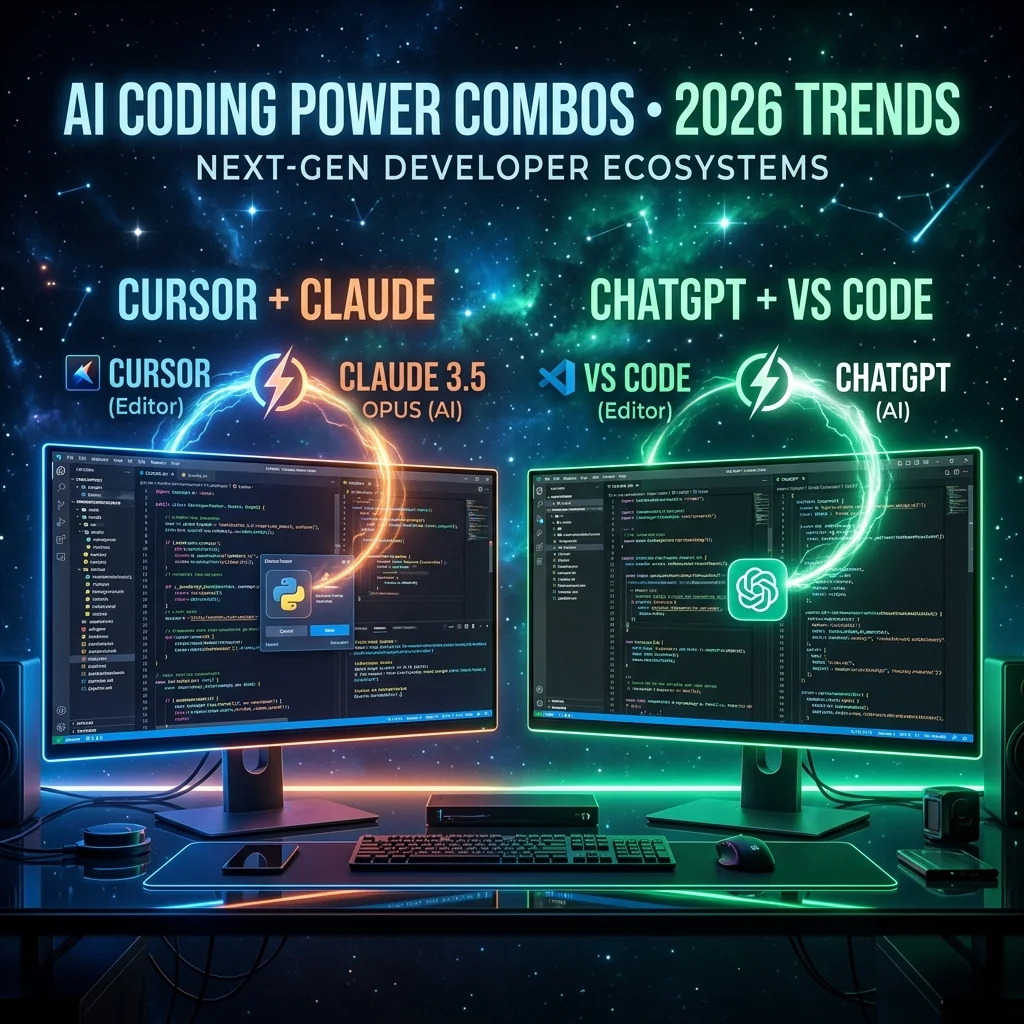
In 2026, the most effective developers do not use a single AI tool — they build deliberate stacks of 2–4 complementary tools, each optimized for a different phase of the development lifecycle. Approximately 73% of engineering teams now use AI tools daily, with tool stacking being the dominant pattern among senior engineers.
Serious Dev Stack
Use Cursor for all in-IDE editing, refactoring, and code completion. Deploy Claude Code via the terminal for complex, multi-file agentic tasks that require frontier reasoning — bug hunts, architecture reviews, full feature branches.
Fast Learning Stack
Use ChatGPT for explanations, debugging, architecture questions, and high-level code reviews. Pair it with GitHub Copilot in VS Code for intelligent inline autocomplete while you write. The most beginner-friendly combination for US developers starting their AI journey.
Complete Tool Comparison: At a Glance
AI Coding Tool Comparison — June 2026
| Tool | Type | Best For | Free Tier | Paid From |
|---|---|---|---|---|
| Claude Code ⭐ | Terminal Agent | Complex backend, agentic tasks | ✅ Yes | $20/mo |
| ChatGPT ⭐ | Conversational AI | Debugging, logic, full projects | ✅ Yes | $20/mo |
| Cursor AI ⭐ | AI-Native IDE | All-in-one professional IDE | ✅ Limited | $20/mo |
| GitHub Copilot | Editor Extension | Enterprise inline completion | ✅ Students | $10/mo |
| Gemini | CLI / Cloud Agent | Web dev, Google Cloud | ✅ Yes | $19.99/mo |
| Bolt.new | App Builder | Instant full-stack prototypes | ✅ Yes | $20/mo |
| Replit AI | Browser IDE | Build and host from one place | ✅ Yes | $25/mo |
| Windsurf | AI-Native IDE | Agentic coding on a budget | ✅ Yes | $15/mo |
What US Developers Need to Know in 2026
The AI coding market in the United States is evolving faster than anywhere else in the world. Three macro-trends define the landscape for US developers specifically:
1. Context Engineering is the New Core Skill. The biggest differentiator between good and great results from any AI tool is how well you structure the context you provide. Tools like Cursor use codebase indexingto understand thousands of files, but the developer's ability to frame problems precisely determines output quality. This is rapidly becoming the most valuable developer skill in 2026.
2. Agentic Safety is a Real Concern. As we documented in our report on the PocketOS database deletion incident, powerful agentic tools require guardrails. US enterprises are now treating AI coding agent governance as a compliance issue alongside data security. Always use staging environments, granular permissions, and human review checkpoints for agentic workflows.
3. The “AI Diploma” Problem. As Sundar Pichai addressed at Stanford's 2026 commencement, new graduates entering the workforce face a fundamental question: AI tools are accelerating what experienced engineers can do, but they require engineering judgment to guide effectively. The market is not replacing developers — it is raising the baseline expectation for what a developer can produce. Fluency with 2–3 AI coding tools is now a baseline hiring expectation at US tech companies.
TechVantage Verdict: Our Pick for Each Developer Type
- 🏢 Enterprise Developer: GitHub Copilot for compliance + Claude Code for complex tasks
- 🚀 Startup Engineer: Cursor AI + Claude Code (the dominant power stack)
- 📚 Learning Developer: ChatGPT + VS Code + GitHub Copilot free tier
- 🎨 Full-Stack Prototyper: Bolt.new or Replit AI for instant full-stack generation
- ☁️ Google Cloud Developer: Gemini Code Assist + Gemini CLI
- 💸 Budget-Conscious Dev: Windsurf (strong free tier, powerful Cascade agent)
Stay updated with every AI development — explore our AI category for breaking coverage of tools, models, and trends in 2026.
Frequently Asked Questions
01.What is the best AI coding tool in 2026?
There is no single 'best' tool — it depends on your workflow. Cursor AI leads in revenue ($2B ARR) and is the top choice for professional developers who want an AI-native IDE. Claude Code is the most-loved tool by satisfaction (cited by 46% of developers in JetBrains' April 2026 survey). GitHub Copilot has the largest user base with 4.7 million paid subscribers. For rapid prototyping, Bolt.new and Replit AI are unmatched.
02.How many developers use GitHub Copilot in 2026?
GitHub Copilot has approximately 4.7 million paid subscribers as of January 2026, marking a 75% year-over-year growth. It is active in roughly 90% of Fortune 100 companies and is responsible for generating about 46% of code in repositories where it is enabled.
03.What is Cursor AI and why is it popular?
Cursor AI is an AI-native fork of Visual Studio Code built entirely around AI-first workflows. It features a powerful 'Composer' multi-file agent that can handle complex refactors using natural language. By February 2026, Cursor reached $2 billion in Annualized Recurring Revenue (ARR) with over 1 million paying users and is used by ~50,000 engineering teams. It is especially popular among professional developers and startups.
04.Is Claude Code better than GitHub Copilot?
They serve different use cases. Claude Code (by Anthropic) is a terminal-native autonomous agent excelling at complex, multi-file backend tasks, frontier reasoning, and full development lifecycle work — from reading a ticket to submitting a PR. It was rated 'most-loved' by 46% of developers surveyed. GitHub Copilot excels as an inline autocomplete tool with superior enterprise security, compliance features, and deep IDE integration. Most power users in 2026 use both.
05.What is Windsurf AI and who acquired it?
Windsurf is an AI-native IDE (similar to Cursor) built around its 'Cascade' agentic system. It is notable for its strong free tier and competitive pricing compared to Cursor. In 2026, OpenAI announced a deal to acquire Windsurf's technology, making it a significant move in the AI IDE market. It is often recommended for developers who want powerful agentic coding capabilities without paying for premium Cursor subscriptions.
06.What is the best AI tool for building apps fast in 2026?
For rapid full-stack app generation with zero configuration, Bolt.new (by StackBlitz) is the top choice — you describe the app and it generates a complete deployable web app in seconds. Replit AI is another strong option, combining browser-based development, AI assistance, hosting, databases, and authentication in one platform. Both are ideal for prototyping, MVPs, and learning, while tools like Cursor + Claude Code are preferred for production-grade codebases.
07.What AI coding tool combos do professional developers use in 2026?
The most popular power-user combo is Cursor AI + Claude Code: Cursor handles the in-IDE editing and refactoring while Claude Code manages complex, agentic multi-file tasks via the terminal. For learning and general development, ChatGPT + VS Code (with Copilot) is the most widely recommended beginner-friendly stack. Approximately 73% of engineering teams use AI coding tools daily in 2026, with most developers using 2–4 tools simultaneously.
08.Is the AI coding tools market growing in 2026?
Yes, significantly. The global AI coding assistant market was valued at approximately $12.8 billion in 2026, with a projected CAGR of 27%, expected to reach $30.1 billion by 2032. About 85% of developers now use AI tools in their workflows. The market has shifted from simple code completion to full 'agentic engineering' where AI can plan, execute, test, and review entire development tasks autonomously.