Nvidia RTX Spark: The AI Superchip Chasing a $200 Billion PC Market
Jensen Huang opened Computex 2026 with a spark — literally. A full fact-checked deep-dive into the RTX Spark superchip, what the spec sheet actually says, which claims hold up, and why this ARM bet is entirely different from the $900M Surface RT disaster.
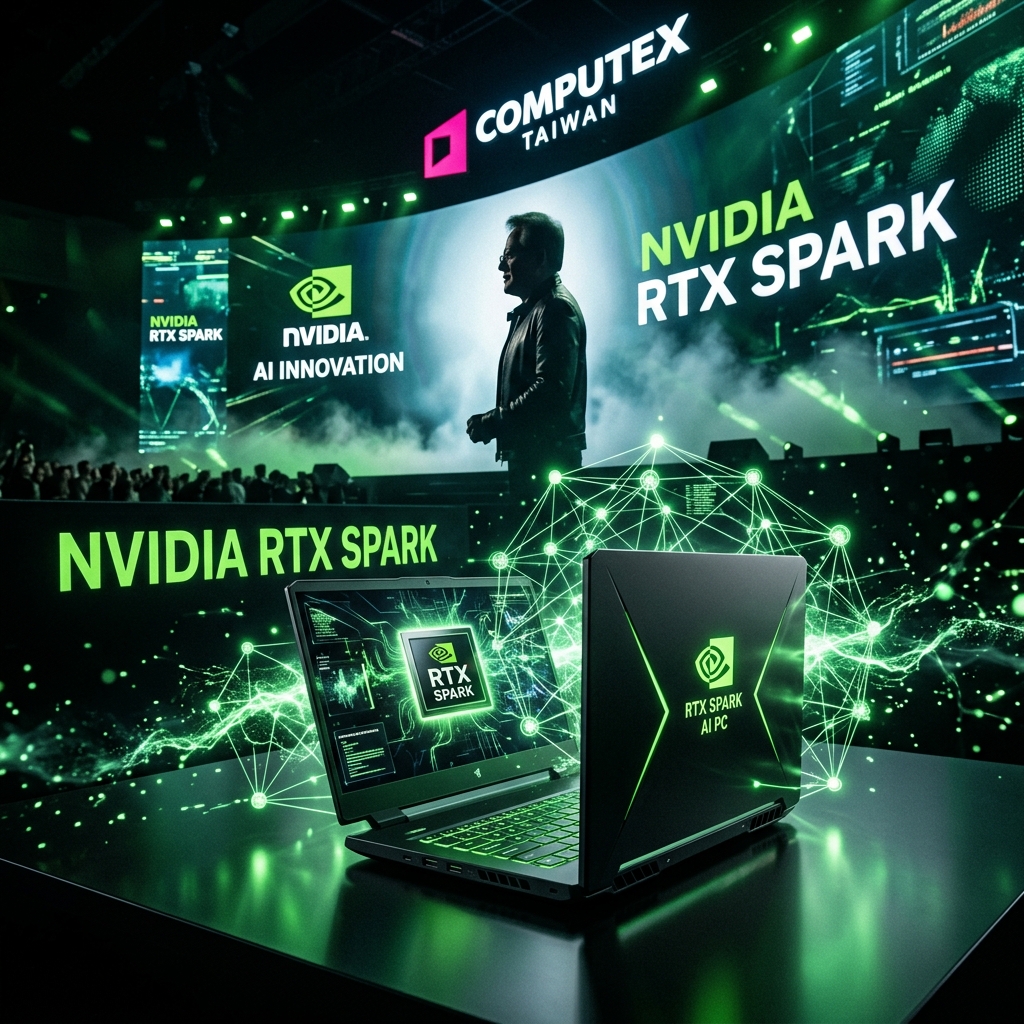
Computex 2026, Taipei: Nvidia CEO Jensen Huang unveils RTX Spark — the ARM-based superchip designed to run AI agents on your PC.
For decades, Nvidia made its fortune on one thing: making your games look spectacular. Then it made another fortune on AI training GPUs. Now Jensen Huang has set his sights on something far more personal — the computer on your desk.
At Computex 2026 in Taipei — one of the world's largest technology trade shows — Nvidia opened the show with the announcement of the RTX Spark, a new ARM-based superchip designed from the ground up to run AI agents locally on Windows PCs. It's a bet that turns every laptop into something closer to a personal AI data center. And it comes with a who's-who list of PC giants ready to ship it: ASUS, Dell, HP, Lenovo, Microsoft, and MSI — with Acer and GIGABYTE following.
But headlines like "1 petaflop of AI compute" and "$200 billion CPU market" deserve scrutiny. Let's go through every major claim in this announcement and separate fact from hype.
01. What Is the RTX Spark? The Spec Sheet, Fact-Checked
The article calls RTX Spark a "CPU" — but that's actually an oversimplification. Verified technical documents from Nvidia's official RTX Spark product page and PCMag's Computex coverage confirm it's a full System-on-a-Chip (SoC) — meaning CPU and GPU die together in a single package:
"1 petaflop of AI compute" — accurate, with context
Confirmed by Nvidia's official RTX Spark page. The 1 petaflop figure refers to FP4 AI precision performance — the same metric used to benchmark AI inference. In traditional FP32 gaming performance, the number is lower. For AI agent workloads, the 1 petaflop figure is the relevant one.
ASUS, Dell, HP, Lenovo, Microsoft Surface, MSI — all confirmed
All six PC manufacturers are verified partners per Tom's Hardware's Computex 2026 coverage. Acer and GIGABYTE are also confirmed to follow with their own RTX Spark devices in a second wave.
Microsoft named it "the most powerful Surface Laptop ever built"
Confirmed. The Surface Laptop Ultra features a 15-inch PixelSense Ultra mini-LED display at 2,000 nits peak brightness, up to 128GB unified RAM, and full port connectivity including HDMI, USB-C, USB-A, and SD card reader. Pricing is estimated in the $3,000–$7,000 range; official pricing has not been released as of this writing.
The "secure sandboxes jointly developed with Microsoft" claim
Nvidia's press release mentions secure agent sandboxing. Nvidia's OpenShell runtimeis confirmed as the agent execution environment. The "jointly developed with Microsoft" framing is broadly accurate — Microsoft has deep integration work on Windows for ARM AI agents — but precise co-development specifics haven't been fully published in technical documentation yet.
"More than 1,000 games and applications" with RTX support
This is in line with existing RTX software ecosystem data. Nvidia's DLSS games databasealready lists well over 1,000 supported titles, and software support from Adobe, Blender, ComfyUI, Riot Games, and Xbox is verified in Nvidia's partner announcement.

02. The $200 Billion CPU Market Claim — Does It Hold Up?
Jensen Huang made headlines on Nvidia's fiscal Q1 2027 earnings call (May 20, 2026) by stating he'd found a new $200 billion market for Nvidia in CPUs. This deserves a careful look.
The claim is verified— Huang and CFO Colette Kress explicitly cited this TAM (Total Addressable Market) on the official earnings call, attributing it to the explosion of agentic AI workloads that require massive CPU resources for reasoning, planning, and task execution. But there's important context:
"We'll have billions of agents, and those billions of agents will all use tools. And those tools are going to be like PCs, just like us humans using PCs today. We're going to need a lot more CPUs." — Jensen Huang, Nvidia CEO, Q1 FY2027 Earnings Call, May 2026
The Vera CPU — Nvidia's ARM-based data center processor — is already on track to generate $20 billion in revenue within Nvidia's current fiscal year, according to analyst projections cited by management on the same call. This isn't speculation: Vera CPUs are actively deployed at Anthropic, OpenAI, SpaceX, and multiple hyperscalers.
03. Why This Is Nothing Like the Surface RT Disaster
The article mentions the 2013 Microsoft Surface RT failure — a fair historical reference, but one that requires critical context. In July 2013, Microsoft wrote off $900 million in Surface RT inventory. The reason? The Surface RT ran "Windows RT" — an ARM-based OS variant that could not run any legacy x86 Windows applications. Users paid premium prices for what felt like a crippled tablet.
The RTX Spark situation is structurally different in every meaningful way:
Surface RT (2013) — What Went Wrong
- ⚠️ Ran "Windows RT" — couldn't run legacy .exe apps
- ⚠️ Powered by Nvidia Tegra 3 — underpowered for full PC workloads
- ⚠️ Positioned as a consumer tablet at PC prices
- ⚠️ App store was nearly empty
- ⚠️ $900M written off; Dell & partners abandoned it
RTX Spark (2026) — What's Different
- ✅ Runs full Windows 11 — complete x86 app compatibility
- ✅ 6,144 Blackwell CUDA cores ≈ RTX 5070 laptop GPU
- ✅ 1 petaflop AI compute — designed for pro workloads
- ✅ 100+ software partners at launch; full CUDA ecosystem
- ✅ Targets creators and developers, not mass-market tablets
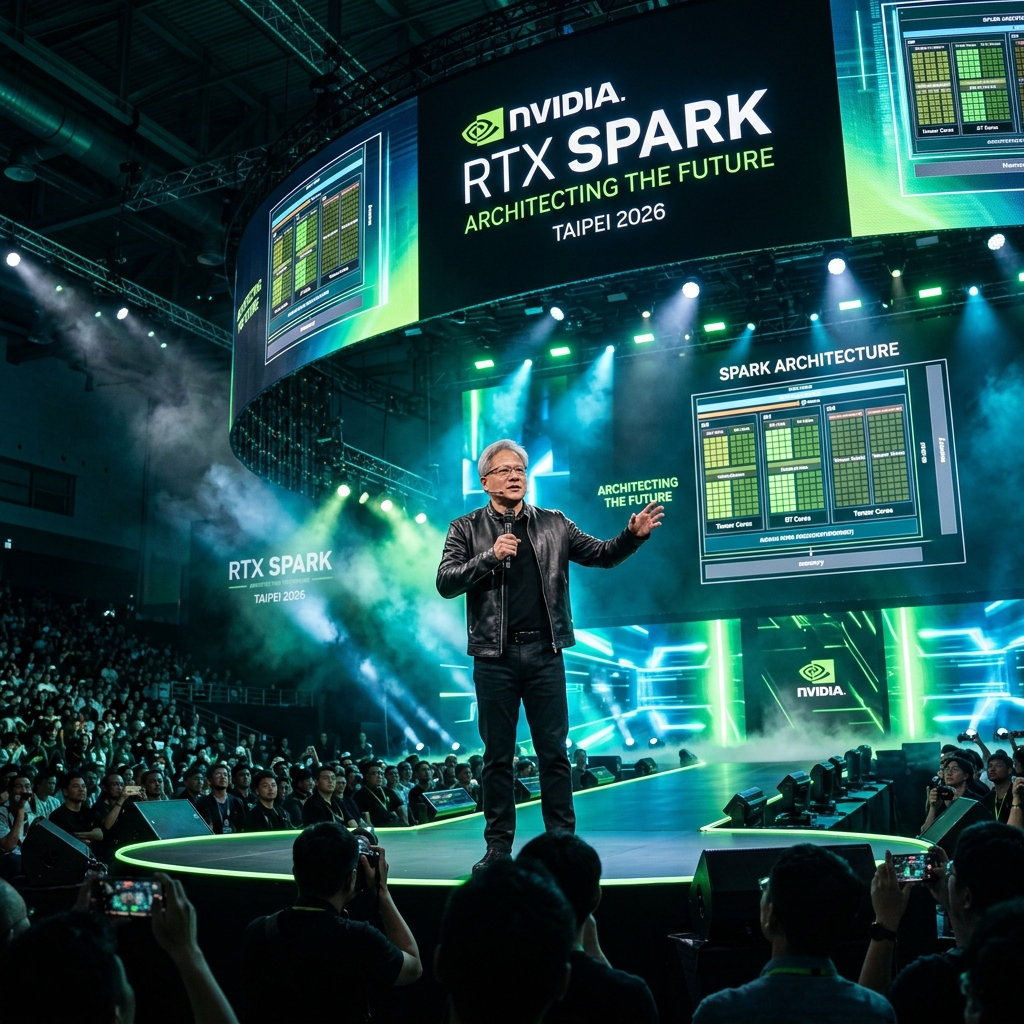
Computex 2026, Taipei — Jensen Huang unveils the RTX Spark platform to the world's largest tech hardware audience.
04.OpenClaw & Hermes Agent: The AI Agents This Chip Is Designed For
Nvidia specifically named OpenClaw and Hermes Agent as example AI agents that the RTX Spark will run securely. These are real, verified frameworks — not marketing buzzwords.
OpenClaw — created by Peter Steinberger (now at OpenAI) — is a modular, ecosystem-first AI agent framework with a "ClawHub.ai" marketplace of pre-built AgentSkills. It can orchestrate tasks across email, Slack, WhatsApp, code review, and more. Hermes Agent, built by Nous Research, prioritizes deep memory persistence — it "learns" your workflows across sessions, building an increasingly personal operating assistant.
Both support local LLM inference via Ollama, LM Studio, or vLLM — and the RTX Spark's 128GB unified memory pool and 1-petaflop AI compute make it the first consumer PC capable of running 120B-parameter models locally at meaningful speeds. Nvidia's NemoClaw toolkit provides blueprints for deploying these agents with sandboxing and runtime safety controls.
05. TechVantage Take: Will It Actually Work?
Jensen Huang has a remarkable track record of being right when everyone else was skeptical. He was right about gaming GPUs. He was right about data center AI. He was right about autonomous vehicles needing custom silicon. Now he's betting that AI agents will need their own dedicated PC hardware ecosystem — and that Nvidia should own it.
The technical case is strong. The 128GB unified memory pool alone solves the single biggest bottleneck for local LLM inference on consumer hardware. Having ASUS, Dell, HP, Lenovo, Microsoft, and MSI all launching products simultaneously eliminates the "chicken and egg" software adoption problem that killed Surface RT.
The real question is price. The Surface Laptop Ultra is estimated at $3,000–$7,000. The DGX Spark mini-computer — the developer version of this same chip platform — starts at $4,800. If these RTX Spark Windows PCs land above $3,000, the addressable market narrows to professionals and power users, not the mainstream consumer segment.
But as our analysis of the best AI coding tools for 2026 shows, developers and AI-forward professionals are exactly the early adopter market that moved the needle for every previous Nvidia platform. The $200B CPU market won't be won in year one — but RTX Spark could be how Nvidia gets a credible foothold. For more context on how AI is reshaping the hardware landscape, read our coverage of how AI is disrupting the job market for new graduates.
Related Keywords
⚡TechVantage Verdict
What the Facts Support
- 1 petaflop AI performance is real and relevant for local LLMs
- $200B CPU TAM claim is verified from earnings call
- All named PC partners are confirmed for fall 2026
- Full Windows 11 — not a repeat of Windows RT
What Still Needs Answering
- Final retail pricing (critical for mass adoption)
- Real-world battery life under AI agent workloads
- Competition from Apple Silicon at the same price points
- Whether AI agents deliver enough value for mainstream users
💡Frequently Asked Questions
What exactly is the Nvidia RTX Spark superchip?
The Nvidia RTX Spark is an ARM-based System-on-a-Chip (SoC) co-developed with MediaTek. It fuses a 20-core Nvidia Grace CPU with a Blackwell-architecture GPU featuring 6,144 CUDA cores, up to 128GB of unified LPDDR5X memory, and delivers up to 1 petaflop of AI compute performance. It is manufactured on TSMC's 3nm node for maximum power efficiency.
Which PC makers are building RTX Spark AI PCs?
Confirmed partners at Computex 2026 include ASUS, Dell, HP, Lenovo, Microsoft (Surface Laptop Ultra), and MSI, with Acer and GIGABYTE expected to follow with their own models. These devices are scheduled to ship in fall 2026.
What is the Microsoft Surface Laptop Ultra and how much does it cost?
The Microsoft Surface Laptop Ultra is Microsoft's flagship RTX Spark laptop, featuring a 15-inch PixelSense Ultra mini-LED display (2880x1920, 262 PPI, 2,000 nits peak brightness), up to 128GB unified RAM, and a comprehensive port lineup. Official pricing has not been disclosed, but industry estimates place it in the $3,000–$7,000 range depending on configuration. It is positioned as 'the most powerful Surface Laptop ever built.'
Is Jensen Huang's claim of a $200 billion CPU market accurate?
Yes — this is a verified claim from Nvidia's fiscal Q1 2027 earnings call (May 20, 2026). Jensen Huang and CFO Colette Kress specifically cited a $200 billion total addressable market for CPUs, driven by agentic AI workloads. The Vera CPU is already generating significant revenue, with Nvidia projecting standalone CPU revenue could reach $20 billion within the current fiscal year.
What are OpenClaw and Hermes Agent — the AI agents Nvidia mentioned?
OpenClaw (created by Peter Steinberger, now at OpenAI) and Hermes Agent (built by Nous Research) are the two dominant open-source AI agent frameworks in 2026. OpenClaw uses a modular 'AgentSkills' marketplace (ClawHub.ai) for multi-platform task automation, while Hermes Agent focuses on deep memory persistence and self-improvement. Both can run locally on hardware like the RTX Spark platform using local LLMs via tools like Ollama or LM Studio.
Didn't ARM-based Windows PCs fail before? What happened with Surface RT?
Yes — in July 2013, Microsoft wrote off $900 million in Surface RT inventory. The tablet ran Windows RT, an ARM-based OS that could only run apps from the Windows Store — not legacy x86 applications — creating a crippling 'app gap.' The RTX Spark situation is fundamentally different: it runs full Windows 11, carries GPU performance equivalent to an RTX 5070 laptop GPU, delivers 1 petaflop of AI compute, and is designed for AI agent workloads rather than consumer tablets.
Can the RTX Spark really run large language models locally?
Yes — this is a verified capability. The chip supports up to 128GB of unified memory and is designed to run 120-billion-parameter LLMs locally with up to 1 million tokens of context. This is confirmed in Nvidia's official RTX Spark technical specifications, enabled by the FP4 precision support and the tight CPU-GPU memory architecture.
Is the RTX Spark a CPU or a GPU chip?
It is technically both — a System-on-a-Chip (SoC) that integrates an ARM-based Grace CPU (20 cores) and a Blackwell-architecture GPU (6,144 CUDA cores) into a single unified package. The article's description of it as a 'CPU' is a simplification; Nvidia markets it as a 'superchip' because of this dual-nature design.