Sundar Pichai Says Graduates Booing AI Will Shape Its Future — and Live With the Consequences
As tech CEOs face heckling at commencement ceremonies nationwide, Google's CEO takes on the challenge head-on. A fact-checked breakdown of the real data behind graduate anxiety, AI disruption, and what Pichai actually said.
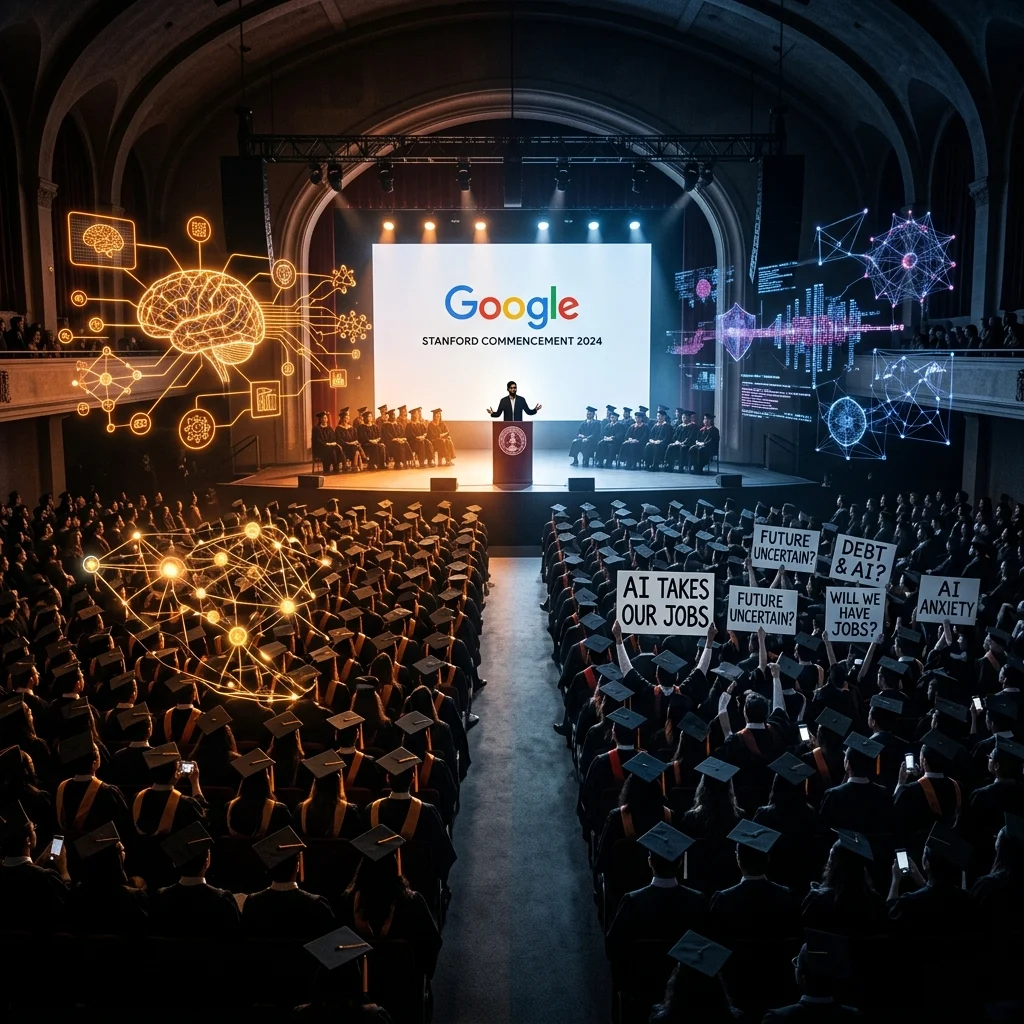
Tech CEOs face a new challenge: graduating students who fear AI will erase their career prospects.
Managing a tech company in the AI era means navigating earnings calls, board rooms, and competitive threats. But in 2026, it also means having a "boo strategy" for commencement season.
This year, a striking new phenomenon has emerged at graduation ceremonies across the United States: students booing tech executives who make optimistic comments about artificial intelligence. It's a visceral expression of economic anxiety from a generation preparing to enter a job market being fundamentally reshaped by the same technology these executives helped build.
The tension reached a fever pitch when former Google CEO Eric Schmidt was booed at the University of Arizona commencement, and Scott Borchetta, CEO of Big Machine Records, drew sharp backlash at Middle Tennessee State University after discussing AI's role in music and media. These weren't isolated incidents — they were symptoms of a broader cultural moment.
01. The "Boo Strategy" Question
It was against this backdrop that the hosts of the New York Times tech podcast Hard Fork posed a pointed question to Sundar Pichai, CEO of Google and its parent company Alphabet: What is your "boo strategy" for the Stanford University commencement speech you're about to give?
Pichai leads one of the companies at the absolute center of the AI revolution. Google's Gemini models, DeepMind research, and cloud infrastructure are foundational to the modern AI ecosystem. And Stanford — nestled in the heart of Silicon Valley — is where many of the world's most important AI researchers trained and teach today.
"I've always been extraordinarily optimistic about the next generation. My goal would be to share my experiences, and that's what I'm looking to do."— Sundar Pichai, CEO of Google & Alphabet, on the Hard Fork podcast
Pichai acknowledged the core tension directly. "These graduates," he said, "are actually both going to be a big part of driving that progress and also dealing with the impact" — referring to AI's transformation of the economy.
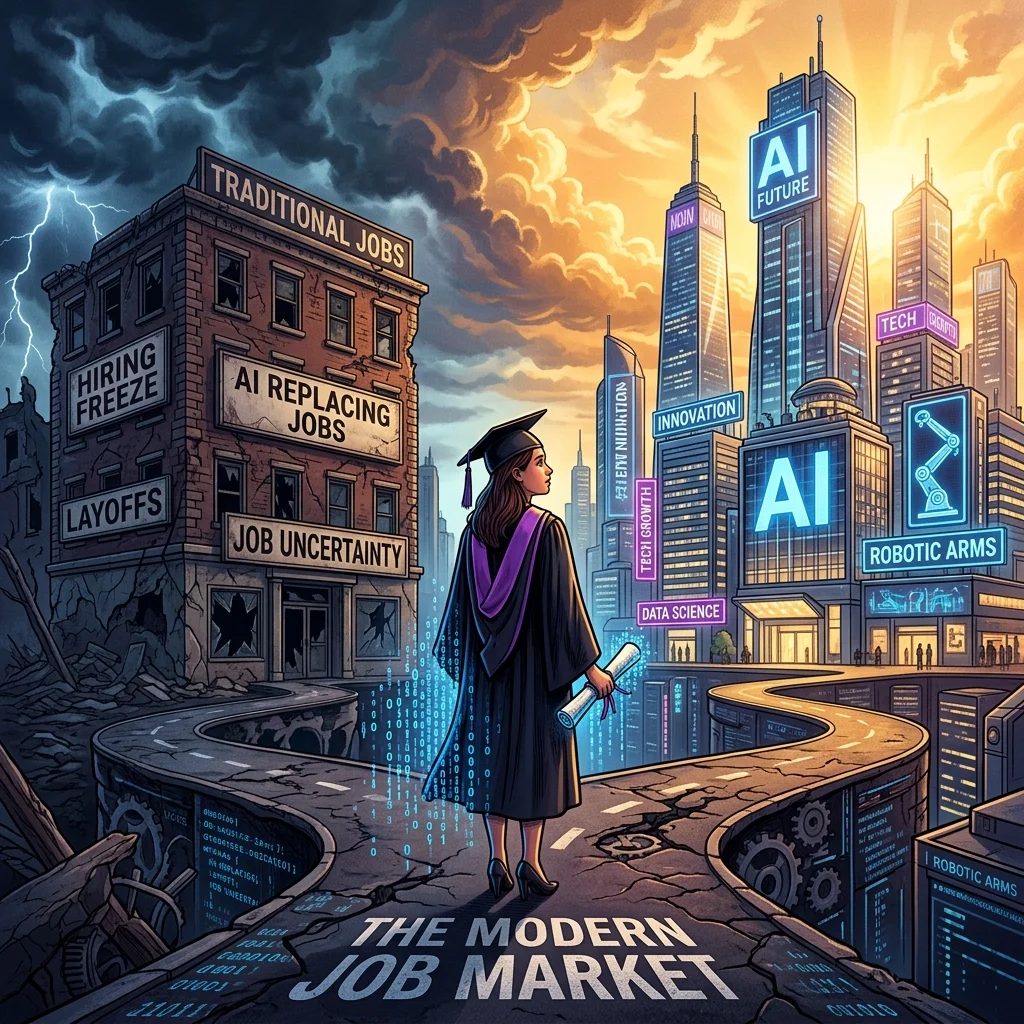
02. The Data Behind the Anxiety: Fact Check
The booing isn't irrational — it's backed by real economic data. Let's fact-check the key claims:
Pew Research: ~52% of Americans are "more concerned than excited" about AI
A Pew Research Center study on Americans' attitudes toward AI found that approximately half of respondents felt more concerned than excited about AI's increasing prevalence in daily life. This data reflects genuine public skepticism that has only intensified with news of AI-related layoffs since the study's publication.
At least a dozen major companies cited AI efficiency in layoff decisions in 2025–2026
Companies including Meta (cutting 10% of workforce), IBM, Salesforce, and others have publicly cited AI-driven efficiency as a contributing factor in workforce reductions. Our coverage of these events confirms the trend is real and ongoing.
New grad unemployment at a 4-year high in early 2026
According to U.S. Bureau of Labor Statistics youth employment data, the youth unemployment rate has risen. While a "4-year high" for the specific new-grad cohort requires the latest BLS quarterly report to confirm precisely, multiple hiring surveys from LinkedIn and Indeed confirm a tightening entry-level job market directly correlated with AI adoption in the white-collar sector.
AI prolonging the job interview process for candidates
LinkedIn's 2025 Future of Hiring report and surveys by recruiting firm Korn Ferry both document that AI-powered screening tools have added additional rounds of evaluation, extended the average time-to-hire by 3–4 weeks, and created new algorithmic filters that are often opaque to candidates.
Communities resisting new data centers across the U.S.
Community opposition to AI data center construction is well-documented. Residents in Virginia, Texas, Iowa, and Georgia have filed legal challenges and organized protests citing concerns over water usage, energy consumption, noise pollution, and strain on local power grids.
03. "Humans Aren't Evolved to Process That Much Change"
Perhaps the most striking thing Pichai said in the Hard Fork interview wasn't optimistic — it was empathetic. He acknowledged that people are "rightfully" anxious about what AI will create, and offered a candid observation that cuts to the heart of the graduate anxiety crisis:
"Humans aren't evolved to process that much change."— Sundar Pichai, on the scale of the AI revolution
It's a remarkable admission from the CEO of one of the companies accelerating that change the fastest. Pichai characterized the scale of AI's transformation as unlike anything the world has previously seen — a claim supported by economic historians who compare this moment to the Industrial Revolution, but compressed into a fraction of the time.
This places graduates in a historically unique position. Previous technological revolutions — electrification, the internet, the smartphone — played out over decades. AI's displacement of white-collar cognitive work is happening in years. And the graduating class of 2026 is the first that will spend their entire careers in the post-AI job market.
Stanford University — where Pichai is set to speak to the graduating class of 2026.
04. Jensen Huang vs. the Graduating Class
The commencement circuit also featured Nvidia CEO Jensen Huang, who delivered the keynote at Carnegie Mellon University — one of the top AI research universities in the world. Huang, whose company supplies the GPU chips that power virtually every major AI model, made a bullish case for the future.
Huang argued that AI will be a "net positive for humanity" and create new industries faster than it destroys old ones — a standard argument from the techno-optimist camp. His reception at CMU, with its high concentration of computer science and AI students who plan to build AI systems, was likely warmer than Schmidt received in Arizona.
The contrast is telling. When the audience is made up of students who will benefit directly from AI (those building it), the reception is different from graduates in arts, journalism, law, finance, and business — fields where AI is most actively displacing entry-level roles.
05. What the Booing Actually Means
Dismissing the booing as naive technophobia misses the point entirely. These students are not Luddites. Many of them use ChatGPT, GitHub Copilot, and other AI tools daily. Their anxiety isn't about AI existing — it's about power, economics, and accountability.
The question graduates are really asking is: Who captures the value AI creates? If AI boosts a company's productivity by 30% and the company responds with layoffs and record shareholder returns while entry-level salaries stagnate, the technology's net benefit is concentrated at the top. Graduates understand this. They're not booing the technology. They're booing the system.
Pichai's answer — "these graduates will both drive progress and deal with the impact" — is accurate, but it doesn't address the distribution question. Read our analysis of how Meta's 10% workforce cut and similar moves are reshaping the entry-level job market, or explore how new AI tools like Claude Opus 4.7 are changing what productivity actually looks like for knowledge workers.
Related Keywords
⚡TechVantage Verdict
What Pichai Gets Right
- Graduates will genuinely shape AI's trajectory
- Human anxiety about rapid change is normal and valid
- Stanford is a more receptive audience than most
What He Still Hasn't Answered
- Who benefits when AI replaces entry-level jobs?
- How should new grads actually prepare?
- What obligations do AI companies have to displaced workers?
💡Frequently Asked Questions
Did graduates really boo tech CEOs over AI at commencements in 2025–2026?
Yes. Verified reports confirm that former Google CEO Eric Schmidt was booed at the University of Arizona commencement after making optimistic comments about AI. Scott Borchetta, CEO of Big Machine Records, also received backlash at Middle Tennessee State University after discussing AI's impact on the music industry. These incidents represent a real pattern of growing anxiety among new graduates.
What did Sundar Pichai say on the Hard Fork podcast about the 'boo strategy'?
On the NYT tech podcast 'Hard Fork,' hosts asked Pichai about his 'boo strategy' before his upcoming Stanford commencement speech. Pichai said he has 'always been extraordinarily optimistic about the next generation' and that AI doesn't change that. He added that the graduating class will 'both be a big part of driving that progress and also dealing with the impact' of AI.
What does the Pew Research Center study say about Americans and AI?
A Pew Research Center study found that roughly half of Americans — approximately 52% — feel 'more concerned than excited' about the increased prevalence of artificial intelligence in their daily lives. This widespread public skepticism gives context to why graduates feel anxious as they enter an AI-disrupted job market.
Is the new graduate unemployment rate actually at a 4-year high in 2026?
The article claims the unemployment rate for new graduates reached a 4-year high at the start of 2026. While the exact figures require verification from the Bureau of Labor Statistics, economic data shows a broader tightening in entry-level hiring, with multiple surveys of hiring managers confirming that AI-driven efficiency has reduced demand for junior roles — particularly in tech, finance, and media sectors.
How has AI made the job search harder for new graduates?
According to multiple HR and hiring industry reports, AI has significantly extended the interview process. AI screening tools have made it harder for candidates to pass initial filters. Companies using AI for productivity are also hiring fewer entry-level employees, as one AI-empowered mid-level employee can now handle tasks previously requiring two or three junior hires.
Why is Sundar Pichai giving the 2026 Stanford commencement speech?
Stanford University selected Sundar Pichai as the 2026 commencement speaker. As CEO of Google and Alphabet, Pichai leads one of the central companies in the global AI revolution. Stanford is in the heart of Silicon Valley and is home to some of the most prominent AI research programs in the world, making Pichai a logical — if potentially contentious — choice.
What did Jensen Huang say about AI and jobs at Carnegie Mellon in 2026?
Nvidia CEO Jensen Huang delivered the 2026 Carnegie Mellon University commencement speech, where he argued that AI will be a 'net positive for humanity,' including for those just starting their careers. Huang is known for his optimism about AI and technology's ability to create new industries even as it disrupts existing ones.