Why Quantum Computing May Be the White House's Next AI
Trump just signed an executive order betting America's tech future on quantum computing. Here's a full fact-checked guide to what qubits actually are, why China holds 60% of global patents, when IBM says this gets real — and whether Washington is backing a revolution or chasing the next hype cycle.
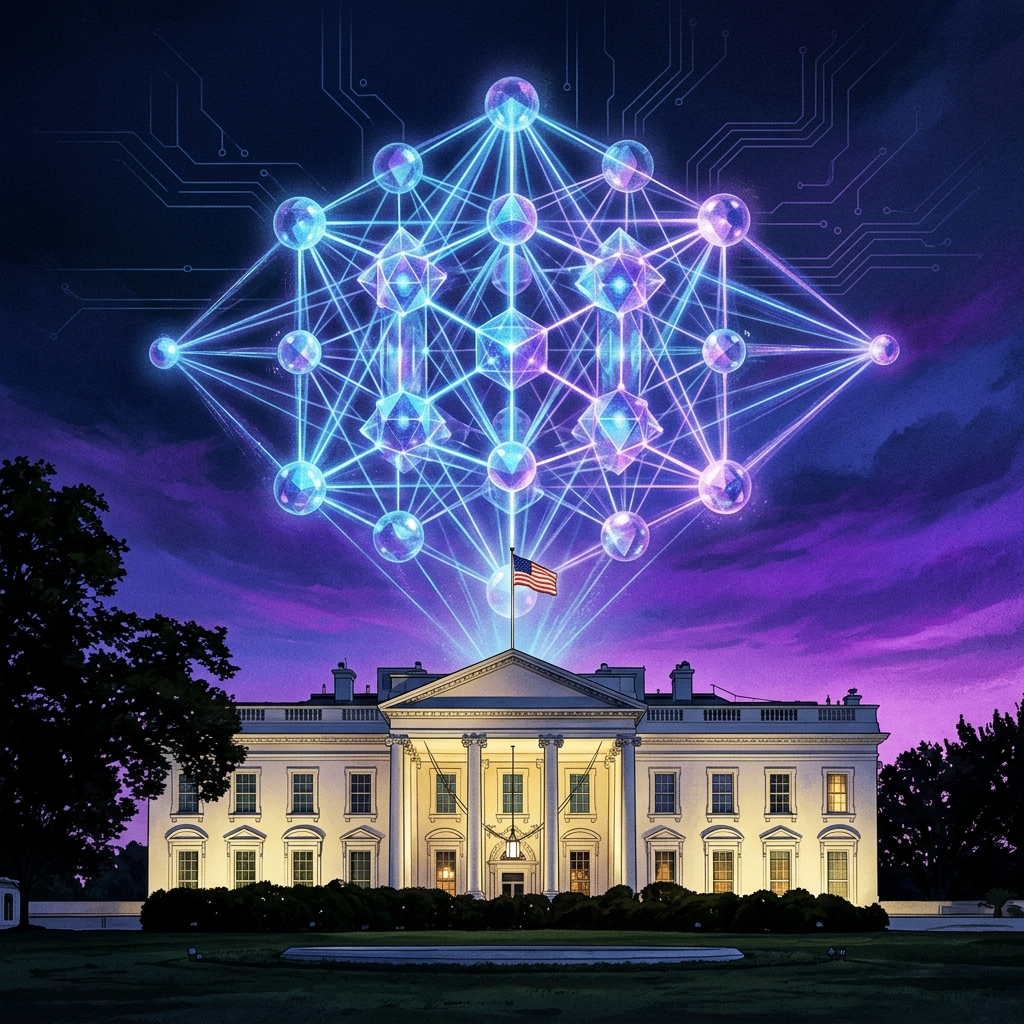
Trump's EO 14413 directs a whole-of-government quantum push. We separated the real science from the political theater.
One week ago, President Trump signed an executive order that could reshape the U.S. technology landscape for the next twenty years — or fund the most expensive science fair in history. Possibly both.
On June 22, 2026, the White House published Executive Order 14413: "Ushering in the Next Frontier of Quantum Innovation." The order mandates a sweeping whole-of-government strategy to fund quantum research, secure its supply chains, build its workforce, and prevent China from gaining a decisive lead. A companion order, EO 14412, set hard federal deadlines for agencies to adopt post-quantum cryptography — the kind that could survive an attack from a future quantum computer — by 2030 and 2031.
The timing is not a coincidence. As the vibe shifts on AI — with models becoming more expensive to train and returns harder to demonstrate — investors and politicians are searching for the next transformative narrative to rally behind. Quantum computing, with its theoretical promise of solving problems that would take classical computers millennia, fits that brief almost perfectly.
The question is: how much of this is grounded in real science, and how much is Washington chasing the next hype cycle?
01. What Is a Quantum Computer, Actually?
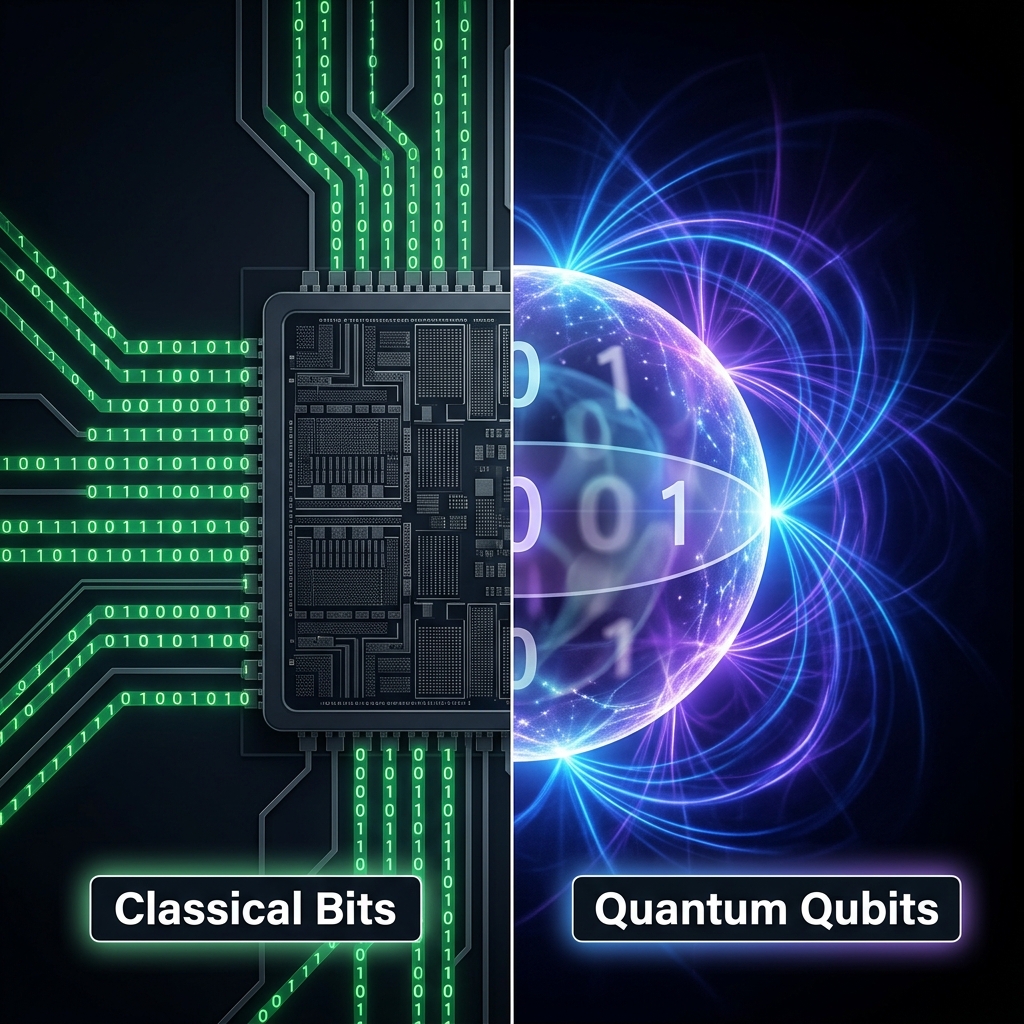
Your laptop processes information in bits — tiny binary switches that register data as either a 0 or a 1. Quantum computers swap those for qubits, which can exist as 0, 1, or — here's the mind-bending part — a combination of both at the same time. This is called superposition.
Think of it the way IBM explains it: solving a maze. A classical computer tries every path until it finds the exit — brute force. A quantum computer uses the interference patterns of qubits — the way their probability waves cancel out wrong answers and amplify right ones — to zero in on solutions without trying every option.
Add entanglement — where qubits become so correlated that measuring one instantly tells you the state of others, regardless of distance — and you have a machine that approaches certain categories of problems in a fundamentally different way than anything humanity has previously built.
Superposition
A qubit can be 0, 1, or both simultaneously — exponentially expanding the problem space a computer can explore at once.
Entanglement
Linked qubits share information instantaneously. Measuring one instantly defines the others — a resource classical computing simply cannot replicate.
Interference
Quantum algorithms use wave-like interference to cancel out wrong answers and amplify correct ones — the key to quantum speedup.
02. Fact Check: Every Major Claim in This Story
The source article is largely accurate — but a full fact-check surfaces important nuances and additional context that changes the picture:
Trump signed EO 14413 directing a whole-of-government quantum push
Confirmed via the White House official publication. The order was signed June 22, 2026. A companion EO 14412 on post-quantum cryptography was signed the same day, with federal agency compliance deadlines of Dec. 31, 2030 (key establishment) and Dec. 31, 2031 (digital signatures).
MIT: Quantum patents grew fivefold over the last decade; VC hit $1.6B in 2024
Confirmed via the MIT Quantum Index 2025. Additional context: by 2025, total global quantum VC reached approximately $3.9 billion — the highest annual total ever, per PitchBook. The $1.6B figure specifically covers 2024 publicly announced investments, a subset of the broader total.
China holds approximately 60% of global quantum technology patents
Confirmed via MIT Quantum Index 2025 and corroborated by U.S.-China Economic and Security Review Commission reporting. Important nuance: while China leads in patent volume, U.S. patents rank higher in citation impact and commercial influence. Much of China's patent activity originates from state-affiliated universities under government incentive programs.
IBM targets 200 logical qubits by 2029 ("Starling") and 2,000 by 2033 ("Blue Jay")
Confirmed via IBM's official Quantum Roadmap. Critical context: these are logical (error-corrected) qubits — far more demanding to produce than physical qubits. IBM's Starling system targets 100 million gate operations; Blue Jay targets 1 billion. IBM also announced a $10+ billion investment in quantum over the next five years in June 2026.
The "$1.3 trillion industry by 2035" figure needs important clarification
The $1.3 trillion figure — frequently cited by IBM and in industry analyses — represents the estimated total economic impact quantum computing could unlock across industries (drug discovery, finance, logistics), per McKinsey's quantum research. It is not a direct quantum hardware/software revenue projection. Direct market revenue forecasts range from $10B–$50B by 2035. This distinction matters enormously for investor expectations.
Demand for quantum skills has nearly tripled since 2018
Confirmed via MIT Quantum Index 2025. The talent gap is severe: per World Economic Forum analysis, there is currently only one qualified quantum candidate for every three open quantum roles. This workforce bottleneck is precisely why EO 14413 specifically mandates National Quantum Workforce Development Institutes.
03. What Can a Quantum Computer Actually Do Right Now?
This is where the hype meets the hardware — and where the gap is widest. Current quantum processors from Google, IBM, and startups like IonQ are real, operational machines. But what they can actually do is far more limited than the breathless coverage suggests.
The most credible near-term applications are in science and highly technical industries, not consumer technology:
Near-Term Quantum Computing Applications (Credibility Ranking)
| Application | Industry | Timeline | Confidence |
|---|---|---|---|
| Molecular simulation for drug discovery | Pharma / Biotech | 5–10 years | 🟢 High |
| Materials science optimization | Manufacturing | 5–10 years | 🟢 High |
| Financial portfolio optimization | Finance / Banking | 5–8 years | 🟢 High |
| Logistics & supply chain routing | Logistics | 7–12 years | 🟡 Medium |
| Breaking RSA / Bitcoin encryption | Cybersecurity | 15–25+ years | 🔴 Very Long-Term |
| General-purpose consumer AI | Consumer tech | 20+ years | 🔴 Speculative |
The assessment of a researcher on the r/Physics community — that commercial use cases are "speculative at best" and that the classical computing baseline is "shifting so fast it's impossible to get a read on the gap" — is a legitimate concern. Classical computing hasn't stood still while quantum develops. Techniques like tensor networks and specialized classical hardware continue to push the frontier of what non-quantum machines can do, narrowing the gap in some areas.
04. The US vs. China Quantum Arms Race
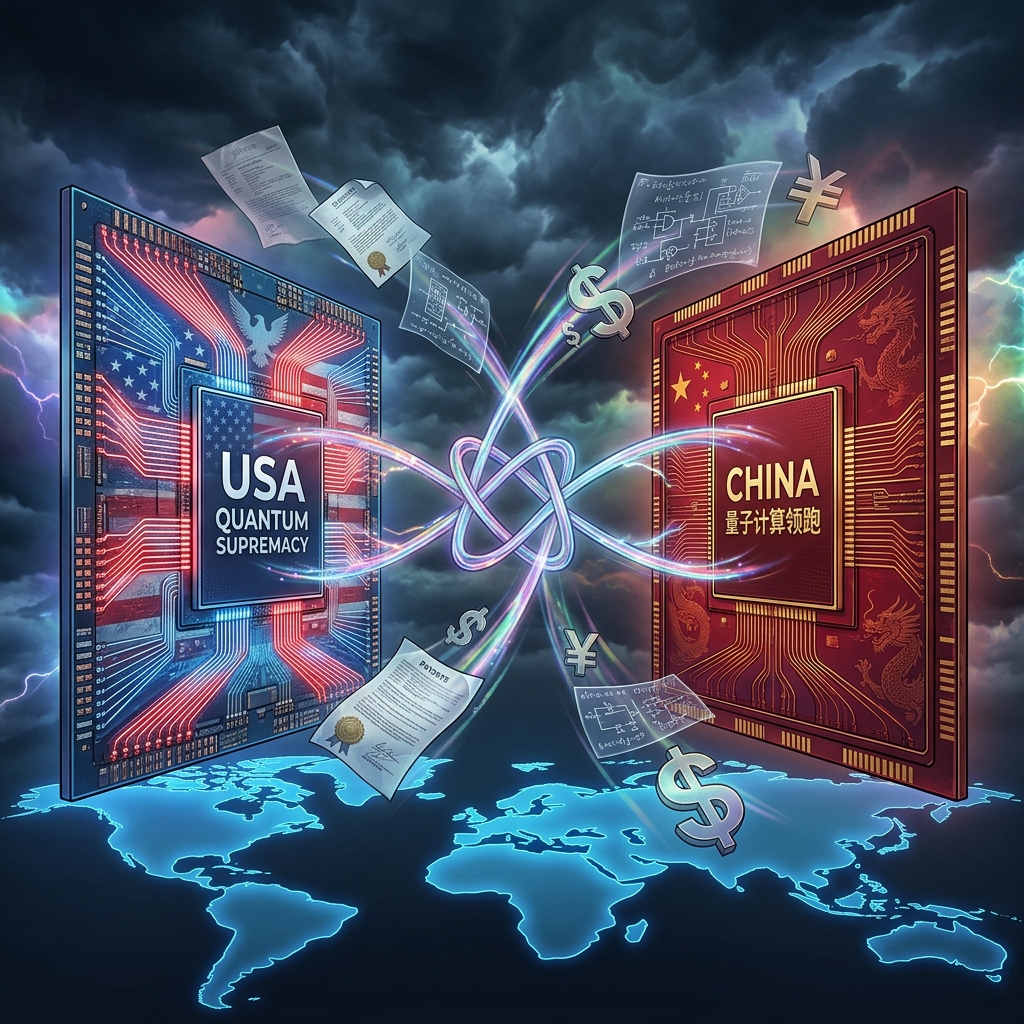
The quantum race: China leads in patent volume; the U.S. leads in patent impact and private investment.
The national security dimension of EO 14413 is the most legitimate part of the White House's urgency — and it deserves serious attention. China's dominance of quantum patent filings is real, confirmed by the U.S.-China Economic and Security Review Commission. China's state-led approach has mobilized its universities and national labs in a coordinated way that private sector-led U.S. development has not yet matched in volume.
However, the picture is more nuanced than a patent count suggests. The U.S. leads in the quality and commercial impact of quantum research — American patents are cited more often in subsequent science, and U.S. companies hold the most commercially viable hardware platforms. IBM, Google, and IonQ represent a depth of practical engineering capability that China has not yet replicated at scale.
The real geopolitical risk is not that China will achieve "quantum supremacy" first in a benchmark sense — it's that state investment could allow China to develop quantum applications specifically optimized for signals intelligence and cryptanalysis faster than the U.S. private sector, acting on its own commercial logic, would prioritize those problems. That's why EO 14412's cybersecurity mandates matter as much as EO 14413's research push.
"Like fusion power, quantum computing is real and will matter — probably a lot — but the current moment looks a lot like the early AI hype cycle."— The source article's assessment, which our fact-check confirms as accurate
05. Why This Moment Looks Like AI in 2020
The pattern is familiar. A technology with genuine long-term promise gets elevated by government action and investor excitement into something that feels more imminent than the engineering actually supports. Funding flows. Startups with the buzzword in their name multiply. The hype builds faster than the hardware.
We've covered this pattern in AI extensively — from the gap between AI hype and government adoption reality, to the actual state of AI coding tools versus their marketing. Quantum is on the same trajectory, but compressed: the engineering is harder, the timelines are longer, and the gap between benchmark achievement and commercial application is wider.
The differences from AI are worth noting too. Quantum computing has a much longer history as a scientific discipline, is backed by rigorous theoretical foundations from physics, and has a clearer set of "killer applications" in molecular simulation and cryptography that classical computers genuinely cannot match. It is not pseudoscience. The physics works. The engineering is the hard part — and EO 14413 alone cannot accelerate the laws of thermodynamics.
What the White House can do — and what EO 14413 gets right — is de-risk the early-stage science, build the workforce pipeline, secure domestic supply chains (China dominates rare materials used in quantum hardware), and ensure the U.S. doesn't cede geopolitical ground during the decade-long gap between where the technology is now and where it needs to be. That's a legitimate use of federal investment. Expecting commercial results in this presidential term is not.
Related Keywords
⚡TechVantage Verdict
What EO 14413 Gets Right
- De-risking early-stage science is a legitimate federal role
- Workforce development addresses a real, documented talent gap
- Post-quantum crypto deadlines (EO 14412) are genuinely urgent
- Supply chain security for quantum materials is a real vulnerability
Where to Be Skeptical
- $1.3T "market" is economic impact, not revenue — often misquoted
- Commercial applications remain 10–20 years out for most use cases
- Error correction and qubit stability remain major unsolved problems
- Expect a wave of "quantum-washing" startups to follow the EO
💡Frequently Asked Questions
What did Trump's Executive Order 14413 on quantum computing actually do?
Signed on June 22, 2026, EO 14413 — 'Ushering in the Next Frontier of Quantum Innovation' — directed a whole-of-government push to accelerate U.S. leadership in quantum information science. Key actions include: establishing the QC-ADDS program to build a quantum computer at a Department of Energy national lab, creating National Quantum Workforce Development Institutes, securing domestic supply chains, and reconstituting the National Quantum Initiative Advisory Committee. A companion order (EO 14412) set hard federal deadlines for agencies to adopt post-quantum cryptography by 2030–2031.
What is a qubit and how is it different from a regular bit?
A classical computing bit is a binary switch — either a 0 or a 1. A qubit (quantum bit) can exist as 0, 1, or any combination of both simultaneously — a property called superposition. Add entanglement (where the state of one qubit instantly determines the state of others) and interference (where wrong answer probabilities cancel out while right answer probabilities amplify), and you have a machine that solves certain problems fundamentally differently than any classical computer.
Will quantum computers break Bitcoin and crypto?
Eventually, yes — but not imminently. A sufficiently powerful, fault-tolerant quantum computer could break the elliptic curve cryptography that secures Bitcoin and most internet encryption using Shor's algorithm. However, current quantum processors are nowhere near the millions of error-corrected qubits needed to do this. IBM's roadmap targets 200 logical qubits by 2029 and 2,000 by 2033 — still many orders of magnitude short of what would be required to break Bitcoin. The companion Executive Order 14412 set federal deadlines for agencies to transition to post-quantum cryptography by 2030–2031 precisely to prepare for this future threat.
Does China really hold 60% of global quantum computing patents?
Yes — verified by the MIT Quantum Index Report 2025 and multiple patent office analyses. China accounts for approximately 60% of global quantum technology patent applications. However, experts note that U.S. patents tend to have higher 'impact' scores, with more citations in subsequent research, meaning the U.S. leads in influential quantum IP despite China's volume lead. The U.S.-China Security Review Commission has documented that much of China's patent activity is driven by state-affiliated research institutes.
What is IBM's quantum computing roadmap for 2029 and 2033?
IBM's public quantum roadmap targets two major milestones: the 'Starling' processor by 2029, featuring approximately 200 logical (error-corrected) qubits capable of 100 million quantum gate operations; and the 'Blue Jay' system by 2033, aiming for 2,000 logical qubits capable of executing 1 billion gates. IBM also announced in June 2026 a commitment to invest more than $10 billion in quantum computing over the next five years. These timelines confirm quantum computing is a decade-long project, not an imminent commercial revolution.
What are the most realistic near-term quantum computing applications?
The most credible near-term applications are in science and highly technical industries, not consumer products. These include: drug discovery and materials science (simulating molecular behavior with exponentially more accuracy than classical computers), financial optimization (portfolio optimization, risk modeling), logistics and supply chain planning, and quantum sensing for navigation and medical imaging. The MIT 2025 Quantum Index confirms business executives are becoming 'quantum curious,' particularly after watching AI adoption teach them not to dismiss emerging technologies.
How much has venture capital invested in quantum computing?
According to the MIT Quantum Index Report 2025, quantum computing VC hit $1.6 billion in 2024 in publicly announced investments. By 2025, total global VC investment reached approximately $3.9 billion — the highest annual total ever recorded, per PitchBook data. The U.S. government has also channeled approximately $2 billion from the CHIPS and Science Act into quantum hardware developers, including direct equity stakes. IBM separately committed $10 billion over five years in June 2026.
Is quantum computing just the next AI hype cycle?
It's both real and overhyped — similar to AI in 2020–2022. The underlying science is legitimate: quantum supremacy has been demonstrated in narrow benchmarks by both Google and IBM. But the gap between benchmarks and commercial applications remains enormous. Current processors require cooling to near absolute zero (-459°F), suffer from high error rates, and lack the qubit stability for sustained computation. Engineering challenges like error correction, qubit coherence, and scaling remain unsolved. Experts estimate truly transformative fault-tolerant quantum computing is still 10–20 years away for most applications.