ChatGPT's Health Launch Is Foreshadowing The Future Of Healthcare: What 300 Million Weekly Users Need to Know
OpenAI has officially launched the Health platform in ChatGPT for US users — allowing you to connect Apple Health, medical records, and lab results for hyper-personalized AI health insights. Here is everything we fact-checked, why it matters, and what it cannot do.
TechVantage Quick Take
OpenAI's new Health in ChatGPT lets US users connect Apple Health, electronic health records, and lab results directly to the chatbot. With 300 million weekly health queries, this is the clearest signal yet that AI is becoming a frontline healthcare companion — but it's not a replacement for your doctor.
What Did OpenAI Actually Launch?
On July 23, 2026, OpenAI officially rolled out the Health platform inside ChatGPT to eligible users in the United States. The feature is available to logged-in users aged 18 and older on Free, Go, Plus, and Pro plans, and works on both web and iOS.
Before this update, individuals could already use ChatGPT to ask about medical conditions, symptoms, treatments, and general health topics. Millions did — and still do. But those conversations lacked personal context. The AI had no way of knowing your specific lab values, medical history, or fitness patterns.
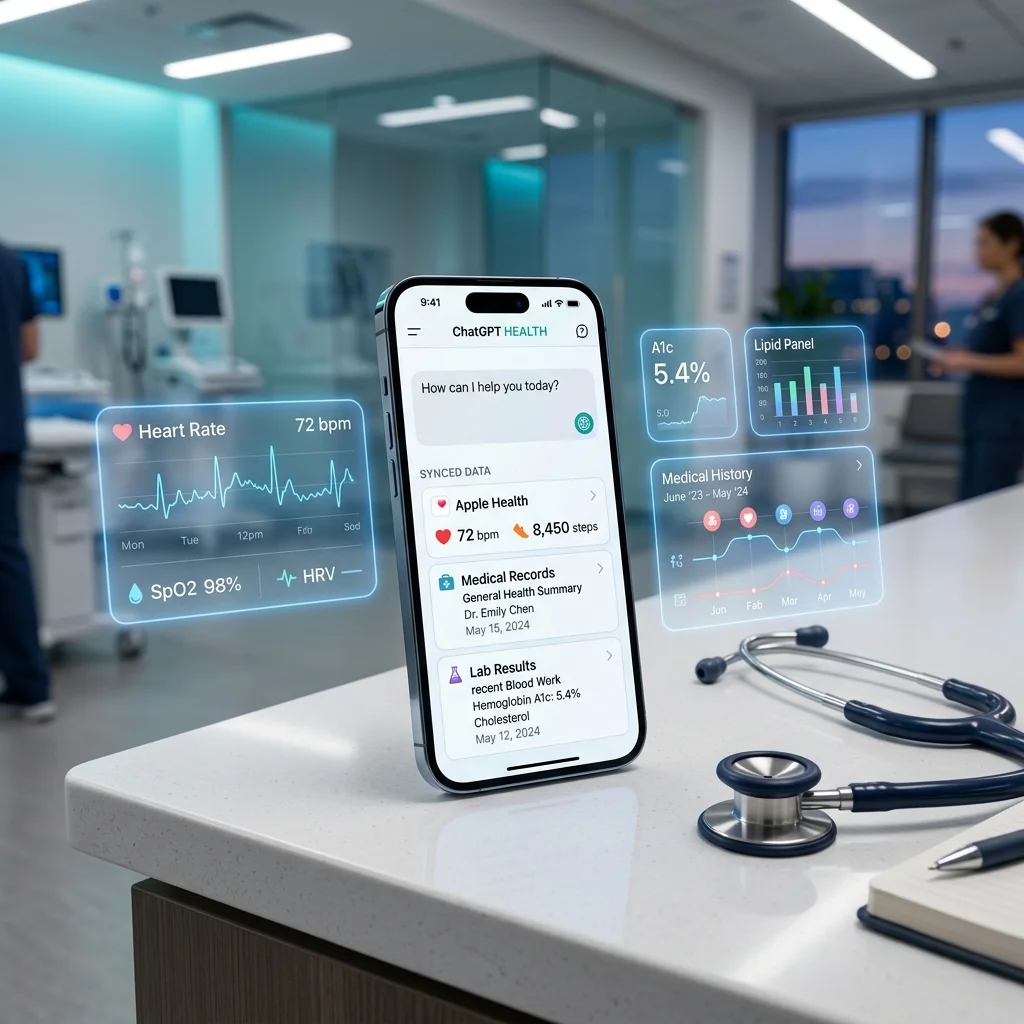
That's what changed. The new Health feature allows users to securely connect their health data from multiple sources:
🍎 Apple Health
Sleep patterns, step counts, heart rate, workouts, and other wellness metrics tracked via iPhone and Apple Watch.
🏥 US Hospital Systems
Electronic health records from hospitals using Epic and Oracle Health platforms, covering diagnoses, medications, and visit notes.
🩺 One Medical
Direct integration with One Medical's patient records, allowing ChatGPT to reference your primary care data.
🧬 Function Health
Detailed biomarker and lab testing data from Function Health's comprehensive testing panels.
Once connected, ChatGPT can reference your data to help you compare new lab results with previous tests, summarize changes since your last doctor's appointment, and explore how your sleep, activity, and workout patterns relate to your overall health. The service is managed through a dedicated "Health" section in the ChatGPT sidebar.
📋 Fact-Check Source: Feature details confirmed via OpenAI's official Health announcement, reporting by PCMag, and coverage by CBS News.

300 Million Weekly Health Queries: Why This Matters
According to reporting by Forbes, OpenAI claims that nearly 300 million usersturn to ChatGPT on a weekly basis with health-related questions. That's not a niche use case — it's a fundamental shift in how Americans seek health information.
Think about that number for a moment. The US population is approximately 340 million. Even accounting for global users, the volume of health queries signals that AI has already become a first point of contact for millions of people trying to understand symptoms, medications, lab results, and treatment options.
However, until now, all of those interactions were generic. If you asked ChatGPT about high cholesterol levels, it would give you a textbook explanation of LDL vs. HDL ranges. Useful — but not personalized. It didn't know your cholesterol numbers, your medication history, or whether your levels had changed since last year.
That's the gap Health in ChatGPT is designed to fill. With connected data, the same question about cholesterol can now produce an answer that references your specific numbers, compares them to your previous results, and contextualizes the answer against your broader health profile.
- Weekly Health Queries ~300 million
- Availability US users, 18+
- Supported Plans Free, Go, Plus, Pro
- Platforms Web & iOS
- Data Used for Training? No
- Launch Date July 23, 2026
Why This Is a Pivotal Moment for Healthcare
For many Americans, AI has already become a household staple for answering questions about complicated topics. These tools have woven themselves seamlessly into daily life — drafting emails, summarizing documents, even handling complex professional tasks. If you're interested in how AI tools are reshaping professional workflows, our coverage of the top AI coding tools for 2026 illustrates the same pattern in the developer world.
The ability to now weave AI across health tracking software and clinical datasets — like Apple Health, Epic EHRs, and Oracle Health — creates unprecedented inroads for everyday users to seek deeper, more tailored health advice. This is the core of what OpenAI has been building toward: contextualized, personalized AI services that go beyond generic answers.
Consider the practical implications. A 55-year-old user in Ohio with Type 2 diabetes can now ask ChatGPT: "How have my A1C levels changed over the past 12 months, and should I be concerned?" — and get an answer that actually references their specific lab history, rather than a Wikipedia-style explanation of what A1C measures.
This kind of hyper-personalization is what will eventually define the next era of consumer health technology. And it's not happening in isolation — Google's Cosmo AI assistant and Gemini Extensions are pursuing similar integration strategies across other domains.

What AI Still Cannot Replace: The Art of Medicine
Here's where we need to pump the brakes. This technology cannot — and should not — replace the judgment of a medical professional. OpenAI itself is explicit about this. The Health feature is designed to support, not replace, professional medical care.
And there's a fundamental reason why, as noted in a thoughtful Forbes analysis by Dr. Sai Balasubramanian: healthcare delivery is not as algorithmic as people think. If it were purely rules-based, healthcare access could have been solved decades ago — even without AI.
Physicians do far more than apply algorithms to symptoms. They take into account the social and psychological dimensions of each patient. A diabetic patient whose A1C is rising might need a medication adjustment — or they might need help dealing with the stress of a recent divorce, which is driving them to skip meals and neglect exercise. An algorithm sees numbers. A physician sees a human being.
This humanistic approach is what helps establish sustainable and practical treatment plans — rather than textbook answers that may be clinically correct but practically infeasible for a specific patient's life circumstances. This is precisely why medicine is often called an art, not purely a science.
⚠️ Important Disclaimer: ChatGPT's Health platform is not intended for medical diagnosis or treatment. OpenAI emphasizes that users should continue to consult healthcare professionals for all medical advice. The tool is designed to improve health literacy and help users understand their data — not to make clinical decisions.
It's also worth noting the legal landscape. Concurrent with this launch, OpenAI faces a lawsuit from a Florida pastor who alleged that ChatGPT provided inaccurate medical advice that led him to delay treatment for a pulmonary embolism. While the outcome of that case is pending, it underscores the risks of relying on any AI system — no matter how sophisticated — for medical decision-making.
📋 Fact-Check Source: Analysis of AI's limitations in healthcare confirmed via Forbes, Fierce Healthcare, and OpenAI's official safety documentation.
Privacy: How Your Health Data Is Protected
One of the biggest concerns with connecting sensitive medical data to any AI system is privacy. OpenAI has addressed this head-on with several commitments:
- 🔒No model training: Your medical records, Apple Health data, and health-related conversations are not used to train OpenAI's foundation models.
- 🚫No ad targeting: Health data is not used for targeted advertising of any kind.
- 🔐Encryption: All health data transmitted to and stored by ChatGPT is encrypted.
- ✅Explicit consent: Users must grant specific permission before ChatGPT can access any health information.
- 🗑️User control: You can disconnect data sources and manage health connections at any time through the sidebar settings.
These commitments are significant — but it's worth noting that privacy in AI healthcare is still an evolving regulatory space. As we covered in our analysis of the KIDS Act passing the House, Congress is actively legislating around data protection, and healthcare data regulations may evolve as AI tools become more clinically integrated.
The Big Picture: Benefits vs. Limitations
What This Enables
- ✅ Personalized health insights based on your actual data
- ✅ Better understanding of lab results and medical records
- ✅ Tracks health trends over time (sleep, fitness, vitals)
- ✅ Free on all ChatGPT plans — no paywall for basic features
- ✅ Health data is not used for AI training or ad targeting
- ✅ Bridges the health literacy gap for millions of Americans
What It Cannot Do
- ⚠️ Cannot diagnose medical conditions
- ⚠️ Cannot prescribe or adjust medications
- ⚠️ Cannot replace physician judgment and clinical expertise
- ⚠️ Cannot account for social and psychological patient context
- ⚠️ Limited to US users on web and iOS only (no Android yet)
- ⚠️ Accuracy of AI interpretations is not guaranteed
What This Means for the Future of US Healthcare
The hyper-personalization of AI in healthcare will undoubtedly help millions of people gain better access to health literacy and general medical knowledge. For Americans who live in rural areas with limited specialist access, or for those who struggle to understand dense medical reports, this is a meaningful step forward.
But as Dr. Balasubramanian at Forbes eloquently notes: "knowledge is ineffective without the wisdom healthcare delivery frequently requires." These services cannot replace healthcare professionals — they can only augment their services and abilities.
The most likely outcome is that AI health tools like ChatGPT's platform will become what calculators are to mathematicians — indispensable tools that enhance capability, but never replace the expertise that gives calculations meaning.
If you're following how major tech companies are expanding AI into everyday consumer services, you may also want to read our analysis of ChatGPT Images 2 and Codex Labs, Google's AI Pro 5TB storage upgrade, and Microsoft Copilot CoWork — all of which illustrate the same trend of AI embedding deeper into professional and personal workflows.
TechVantage Bottom Line
ChatGPT's Health platform is a landmark moment — not because it solves healthcare, but because it makes AI-powered health literacy accessible to hundreds of millions of users at no additional cost. The ability to contextualize generic medical information against your own data is genuinely useful. But the real value of this tool will only be realized when users treat it as a supplement to professional medical care, not a substitute for it.
Healthcare is an art, not purely a science. AI can help you understand the canvas — but you still need a physician to paint the picture.
Frequently Asked Questions
Q: What is ChatGPT's new Health platform?
Health in ChatGPT is a new feature launched on July 23, 2026 that allows US users to securely connect their personal health data — including Apple Health records, electronic health records (EHRs) from US hospital systems, and data from providers like One Medical and Function Health — directly to ChatGPT for personalized health insights and contextualized answers.
Q: Is ChatGPT's Health feature free to use?
Yes. The Health feature is available to logged-in users aged 18 and older in the United States across all ChatGPT plans, including Free, Go, Plus, and Pro tiers. It is currently accessible on web and iOS platforms.
Q: Does OpenAI use my health data to train its AI models?
No. OpenAI has explicitly stated that connected medical records, Apple Health information, and conversations that utilize health data are NOT used to train their foundation models or for targeted advertising. The data is encrypted and requires explicit user permission to access.
Q: Can ChatGPT replace my doctor?
No. OpenAI explicitly states that the Health platform is designed to support — not replace — professional medical care. It is not intended for medical diagnosis or treatment. Users should continue consulting healthcare professionals for medical advice, diagnosis, and treatment decisions.
Q: What kind of health questions can I ask ChatGPT now?
With connected health data, you can ask ChatGPT to compare recent lab results with previous tests, summarize changes since your last doctor's visit, explore how sleep, activity, and workouts relate to your health routine, and get personalized context for understanding your medical records and health metrics.
Q: How many people use ChatGPT for health questions?
According to OpenAI, approximately 300 million users turn to ChatGPT for health-related questions on a weekly basis. This enormous demand for personalized, context-aware health insights was a primary driver behind developing the integrated Health platform.
Q: What health data sources can I connect to ChatGPT?
Currently, you can connect Apple Health (via iPhone), medical records from various US hospital systems including those using Epic and Oracle Health platforms, as well as data from One Medical and Function Health. Users manage all connections through the 'Health' section in the ChatGPT sidebar.