AWS Bets $1 Billion on Embedding AI Engineers Inside Your Business
Amazon Web Services just launched the most ambitious engineer-embedding program in cloud history. Here's every fact-checked detail — the 45-45-45 framework, who's already signed up, and why this is Amazon's most direct strike yet at OpenAI and Anthropic.
AWS launches a $1B Forward Deployed Engineering unit — the first hyperscaler to make this bet at scale.
The hottest trend in enterprise AI isn't a new model. It's a new type of employee — one who works inside your company, on your problems, with your data, for weeks at a time.
On June 30, 2026, Amazon Web Services made the largest single bet on this model yet: a $1 billion investment in a brand-new Forward Deployed Engineering (FDE) organization. The announcement, confirmed by AWS VP of Frontier AI Engineering and Services Francessca Vasquez and detailed in an official Amazon blog post, signals that the race to embed AI expertise inside customer businesses has reached hyperscaler scale.
The term "Forward Deployed Engineer" was coined by Palantir Technologies more than a decade ago. Palantir built its entire enterprise software business on the model of embedding engineers directly with defense and intelligence agencies. In 2026, that playbook has been adopted by every major AI lab — and now by the world's largest cloud provider.
01. What AWS Is Actually Building
This is not a consulting repackage or a rebrand of existing AWS Professional Services. According to Vasquez, the FDE unit represents a structural change: "Getting everybody together in one business unit with a common rubric of deployment. It's the first time we're doing it in that way."
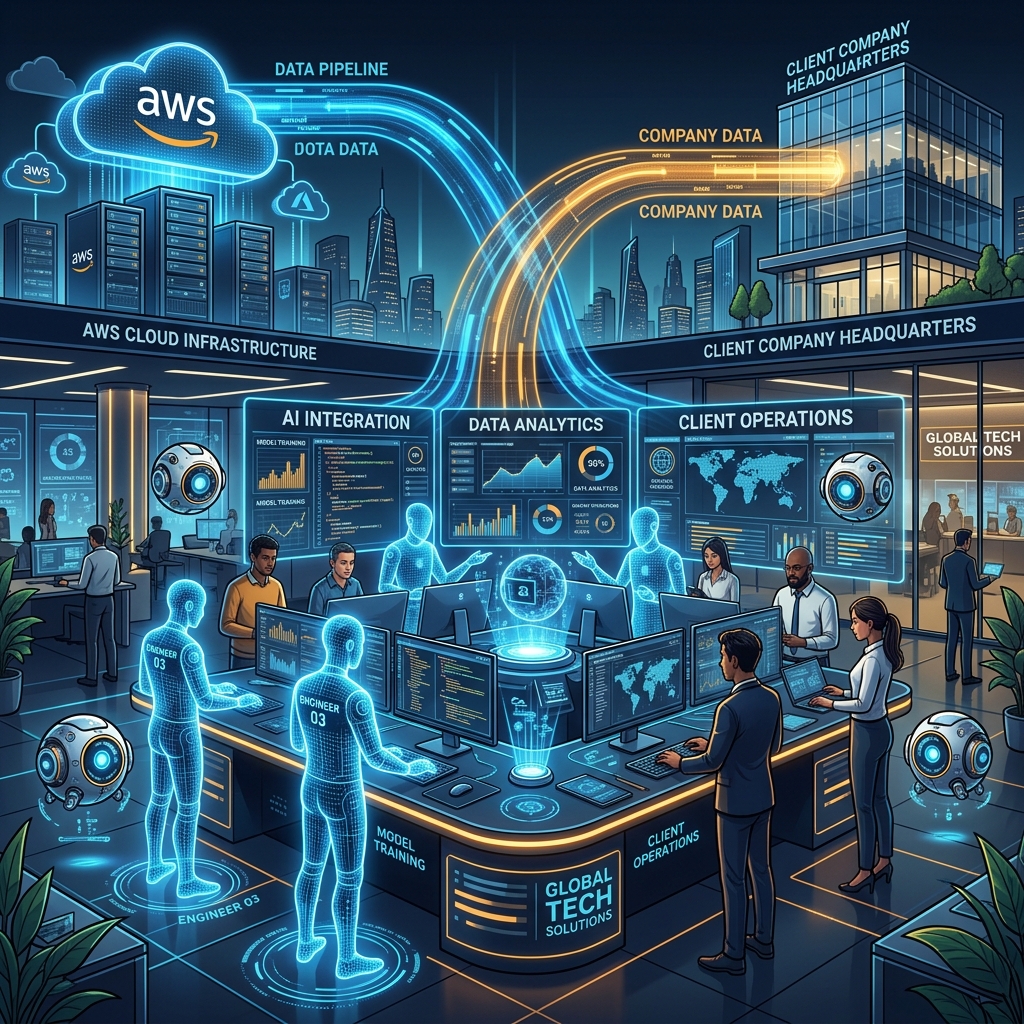
The deployment model works like this: a pod of five to six AWS engineers — many of whom are the same experts who build AWS's own AI services — is embedded directly within a customer's business, engineering, and security teams. Critically, these engineers work alongside purpose-built AI agents, not instead of them. The goal is to multiply human expertise with agentic automation.
"The currency that the customers are always talking about right now is speed. We do see FDE being a choice for customers who are looking for accelerated value back to their stakeholders, their customers, their executive teams."— Francessca Vasquez, VP of Frontier AI Engineering & Services, AWS
AWS has codified this speed obsession into what it calls the "45-45-45" framework: 45 minutes to ideate on the problem, 45 hours to validate the concept, and 45 days to ship a production-ready AI solution. The engagements are explicitly designed to be temporary — AWS aims to leave customers with self-sufficient teams and new internal capabilities, not a long-term consulting dependency.
02. Fact Check: Is Every Claim in This Story True?
Before we go further, let's run every major claim through a rigorous fact-check. The original CNBC report is accurate, but our research surfaced important additional context:
AWS announced a $1 billion FDE investment on June 30, 2026
Confirmed via the official Amazon press release on aboutamazon.com and corroborated by CNBC's original report. The $1 billion is funded entirely from Amazon's balance sheet — no private equity involvement.
Palantir coined the term "Forward Deployed Engineer" over a decade ago
Palantir's FDE model, documented in its official "How Palantir Works" documentation, dates back to its early 2010s government deployments. The company built its entire go-to-market around embedding engineers with the U.S. intelligence community and military before expanding to commercial sectors. This context is critical — AWS is adopting a proven model, not inventing one.
Anthropic announced its FDE company in May 2026 with $1.5B from Blackstone, H&F, and Goldman Sachs
Confirmed via Anthropic's official announcement and Blackstone's press release. The structure: $300M each from Anthropic, Blackstone, and Hellman & Friedman; $150M from Goldman Sachs. Additional co-investors include General Atlantic, Apollo Global Management, and Sequoia Capital.
OpenAI launched DeployCo in May 2026 with $4B+ from TPG, Advent, Bain, and Brookfield
Confirmed via OpenAI's official press release. Key detail not in the original article: OpenAI simultaneously acquired Tomoro, an applied AI consulting firm, giving DeployCo an immediate workforce of ~150 experienced FDEs. OpenAI's entity raised more than $4 billion from 19 investors across a broad private equity and strategic investor base.
The article says AWS is "the first hyperscaler" to do this — that's true, but incomplete
AWS is indeed the first hyperscaler (among Amazon, Microsoft Azure, and Google Cloud) to formalize a dedicated FDE business unit at this scale. However, both Google and Microsoft have had embedded professional services teams for years. What's genuinely new is the structural consolidation into a single unit and the explicit "agentic-first" model where AI agents work alongside humans. This distinction matters for enterprise buyers evaluating vendors.
03. Who's Already Signed Up (And Why It Matters)
AWS has moved quickly on early adopters. The following organizations are already live with FDE engagements — and the list is revealing:
Confirmed AWS FDE Early Adopters (2026)
| Organization | Sector | Why It's Significant |
|---|---|---|
| Allen Institute for AI (AI2) | Research / Non-Profit | Top-tier AI research org — validates FDE for technical users |
| National Basketball Association (NBA) | Sports / Media | Major consumer brand — shows FDE viability beyond tech |
| National Football League (NFL) | Sports / Media | $20B+ league with complex data and broadcast AI needs |
| Ricoh | Enterprise Technology | Global manufacturing/tech — validates FDE for industrial AI |
| Southwest Airlines | Aviation / Transport | Highly regulated sector — shows FDE for compliance-heavy ops |
| Cox Automotive | Automotive / Marketplace | Largest auto data provider — AI-native workflows at scale |
The pattern in these early adopters is deliberate. None are pure-play technology companies. They are large, operationally complex enterprises in sports, aviation, manufacturing, and automotive — sectors where AI adoption has lagged due to legacy infrastructure, regulatory constraints, and the sheer volume of diverse datasets. These are exactly the customers who most need an expert team embedded on-site to make AI work.
04. The Three-Way Battle: AWS vs. OpenAI vs. Anthropic
AWS's announcement doesn't exist in a vacuum. It arrives weeks after both of its biggest rivals in AI services made their own FDE moves — and the structural differences are significant:
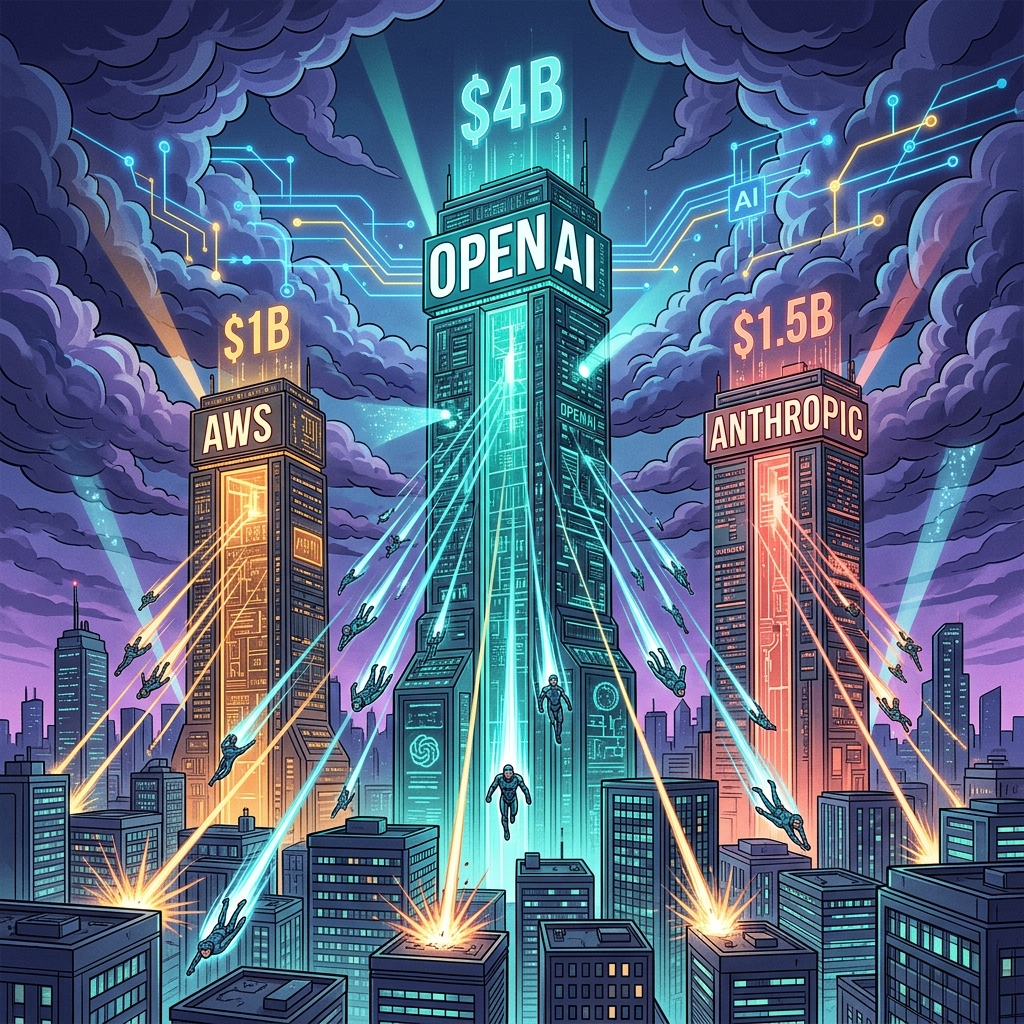
The FDE arms race: AWS, OpenAI, and Anthropic are all competing to embed engineers inside the enterprise.
- ✅ Funded from Amazon balance sheet
- ✅ Internal business unit (not a JV)
- ✅ Model-agnostic (uses all major AI models)
- ✅ Integrates with full AWS stack
- ⚡ "45-45-45" speed framework
- ✅ 19 investors including TPG, Bain, Brookfield
- ✅ Acquired Tomoro for immediate 150 FDEs
- ✅ Majority-owned by OpenAI
- ⚠️ GPT model dependency
- ⚡ Led by COO Brad Lightcap
- ✅ Blackstone, Goldman, H&F as partners
- ✅ Targets mid-sized businesses
- ✅ Standalone new company structure
- ⚠️ Claude model dependency
- ⚡ Focus on PE portfolio companies
The key differentiator for AWS is its model-agnostic posture. While OpenAI's DeployCo and Anthropic's services company are tied to their respective models, AWS FDEs can deploy across the full range of models available on Amazon Bedrock — including Anthropic's Claude, Meta's Llama, Mistral, and AWS's own Amazon Nova. A spokesperson confirmed that AWS expects to work alongside the FDE companies from both OpenAI and Anthropic, not compete with them directly.
For an in-depth look at how AI models compare as coding tools in enterprise environments, or our analysis of the massive Anthropic-Amazon compute partnership that sits underneath much of this FDE strategy, read our related coverage.
05. Why "Speed" Is the Only Thing Customers Are Asking For
The most revealing thing about AWS's FDE pitch isn't the investment amount or the deployment model — it's the problem it's solving. Vasquez's comment that "speed" is the dominant customer demand cuts to the heart of where enterprise AI adoption has gotten stuck.
Most large enterprises have successfully built AI pilots. The challenge is moving from a controlled 6-week proof of concept to a production system that handles real data, real users, real security requirements, and real regulatory constraints. This "deployment gap" — the distance between a promising demo and a working product — is precisely what FDE units are designed to close. It's a problem that can't be solved by buying more cloud credits or licenses. It requires humans embedded in the problem.
According to McKinsey's 2025 State of AI report, only 11% of companies that have piloted generative AI have successfully deployed it at scale across their organization. The bottleneck is almost always engineering capacity and institutional knowledge — exactly what an FDE pod provides.
AWS's plan to next target highly regulated industries with diverse datasets is a direct shot at financial services, healthcare, and legal sectors — all areas where this deployment gap is widest. These sectors have enormous AI potential but face regulatory scrutiny that makes cautious, expert-guided deployment a requirement, not a luxury.
Related Keywords
⚡TechVantage Verdict
What Makes AWS Unique Here
- $1B from its own cash — no PE dilution or external pressure
- Model-agnostic: deploys Claude, Llama, Nova, or any Bedrock model
- Integrates with the full AWS ecosystem (Bedrock, SageMaker, S3)
- Self-sufficiency goal: leaves customers capable, not dependent
Open Questions to Watch
- How does AWS price FDE engagements (per-engagement vs. subscription)?
- Can "thousands" of FDEs maintain consistent quality at scale?
- How will partner programs with OpenAI and Anthropic FDEs work?
- Will Azure or Google Cloud respond with a similar initiative?
💡Frequently Asked Questions
What is AWS's Forward Deployed Engineering (FDE) unit?
AWS's Forward Deployed Engineering unit is a newly announced $1 billion division that embeds small pods of AWS engineers — typically 5 to 6 per engagement — directly inside customer organizations. These engineers work alongside AI agents to build, deploy, and hand off production-ready AI systems, aiming to leave customers with new internal capabilities within weeks rather than months.
How much is AWS investing in the FDE unit?
AWS is investing $1 billion into the Forward Deployed Engineering unit, funded entirely from Amazon's own balance sheet. This distinguishes it from the rival models offered by OpenAI (which raised $4 billion from private equity) and Anthropic (which raised $1.5 billion from partners like Blackstone and Goldman Sachs).
What is the '45-45-45' framework AWS uses?
The '45-45-45' framework is AWS's speed-focused engagement model: 45 minutes to ideate on a problem, 45 hours to validate the concept, and 45 days to ship a production-ready AI solution. This framework is designed to address the main customer demand AWS sees — speed to value.
Which companies are already working with AWS FDE teams?
Organizations already working with AWS Forward Deployed Engineering teams include the Allen Institute for AI (AI2), the National Basketball Association (NBA), the National Football League (NFL), Ricoh, Southwest Airlines, and Cox Automotive, according to AWS's official announcement.
How does AWS FDE differ from OpenAI's Deployment Company?
The core difference is ownership and funding structure. OpenAI's Deployment Company (DeployCo) raised over $4 billion from 19 investors including TPG, Advent International, and Brookfield, and operates as a separate majority-owned entity. AWS funds its FDE unit entirely from its own balance sheet, keeping it as an internal business unit rather than a joint venture.
What is Anthropic's equivalent of an FDE company?
In May 2026, Anthropic announced a new $1.5 billion AI-native enterprise services company backed by Blackstone ($300M), Hellman & Friedman ($300M), Goldman Sachs ($150M), and others. Unlike AWS's internal model, Anthropic's version is a standalone company designed to embed Claude AI deployment expertise within mid-sized businesses.
Who leads AWS's Forward Deployed Engineering unit?
The AWS FDE division is led by Francessca Vasquez, Vice President of Frontier AI Engineering and Services at AWS. She described the unit as the first time AWS has brought all its deployment capabilities together into one business unit with a common engagement model.
What industries will AWS FDE target next?
According to Francessca Vasquez, companies in highly regulated industries with diverse datasets will be the next group of FDE adopters. This includes sectors like financial services, healthcare, legal, and government — all industries where AI deployment requires careful compliance and security co-design.