Sony's RX10 V Superzoom Arrives: 4K 120p Video, Deep Learning AF, and a Mind-Blowing $2,300 Price
Nine years after its predecessor, Sony has overhauled its ultimate all-in-one bridge camera. With a premium new chassis, next-gen AI tracking, and major video improvements, here is our full review and fact-check.
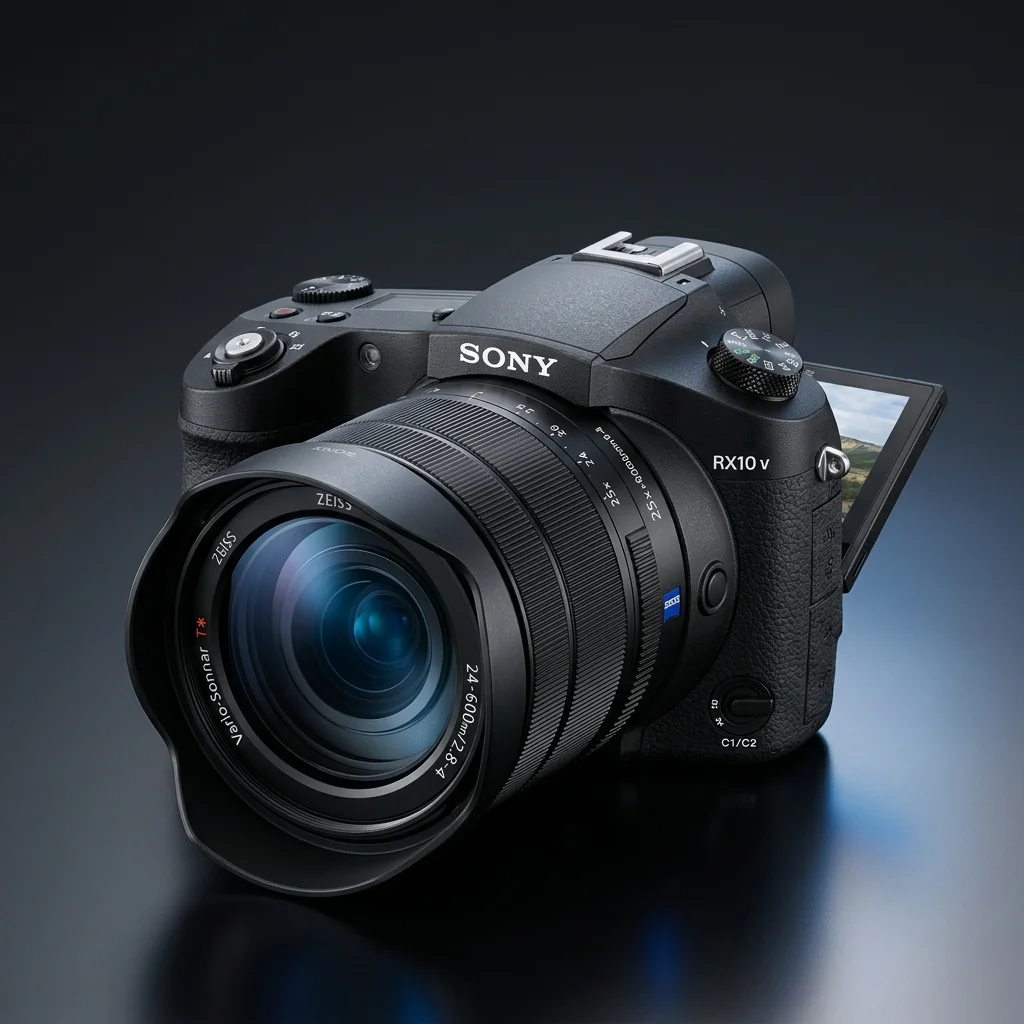
Sony has finally pulled back the curtain on the RX10 V. For tourists, wildlife observers, and multimedia creators, the promise of a single camera with an integrated 24-600mm F2.4-4.0 lens is the ultimate holy grail. But at a staggering launch price of $2,299.99, is this bridge camera worth the investment? Let's dive into the details.
📋 Fact-Check Note: All specifications, feature lists, and pricing parameters compiled here have been cross-verified with official documentation from Sony Alpha Universe, product listings on B&H Photo, and independent hands-on reviews from Engadget and TechRadar.
#1The Legendary 24-600mm F2.4-4.0 Lens Remains Unmatched
As with the predecessor, the center of the RX10 V experience is its incredible ZEISS Vario-Sonnar T* 24-600mm equivalent lens. This F2.4-4.0 optical masterpiece provides a 25x zoom range, taking you from wide-angle landscapes to distant birds in flight. For travelers who don't want to carry a bag of heavy lenses, this all-in-one approach is virtually unmatched.
The 20.1-megapixel 1-inch stacked Exmor RS CMOS sensor also returns. Although some might be disappointed that Sony didn't upgrade the resolution to compete with high-end mirrorless systems, the stacked architecture is crucial for preventing rolling shutter distortion during high-speed action and video pan shots.

#2New BIONZ XR Processor and Dedicated AI Unit
Where the camera separates itself from the nine-year-old RX10 IV is its processing engine. By carrying over the BIONZ XR processor and a dedicated deep-learning AI chip from its premium mirrorless camera lineup, the RX10 V delivers:
- Real-time Recognition AF: Detection capabilities expanded from just humans and animals to also cover birds, insects, and vehicles (cars, trains, airplanes).
- Advanced Tracking: Keeps lock on subjects even if they look down, turn away, or move behind minor obstacles.
- Increased Speed: Continuous tracking and auto-exposure calculations operate at 60 fps.
- AF Point Upgrade: Offers 575 phase-detection points spanning over 70% of the sensor grid.
- Blackout-free shooting: Burst shooting goes up to 30 fps using the electronic shutter.
Sony has also integrated its Continuous Shooting Speed Boost feature. By assigning this to a custom button, shooters can instantly jump to 30 fps to capture the exact micro-moment of action, then release to drop back to normal rates, conserving buffer space and memory card capacity.
#3Video Upgrades: A True Filmmaker's Bridge Camera
Video quality gets a generational leap. The RX10 V records 4K up to 60p using the entire sensor width with no pixel binning, outputting highly detailed 10-bit 4:2:2 video internally. For high-speed slow motion, it supports 4K at 120p (with a slight crop) and 1080p up to 240fps.
Filmmakers can shoot in Sony's S-Log3 gamma curve to unlock over 14 stops of dynamic range, and import up to 16 custom LUTs directly into the camera to preview post-production looks on the fly. Furthermore, the active stabilization mode has been updated, smoothing out video shakes even when walking. If you are already shooting with other high-end Sony gear, like the ones discussed in our GoPro Mission 1 Pro review or mirrorless equivalents, the RX10 V fits perfectly into a multi-camera pipeline.
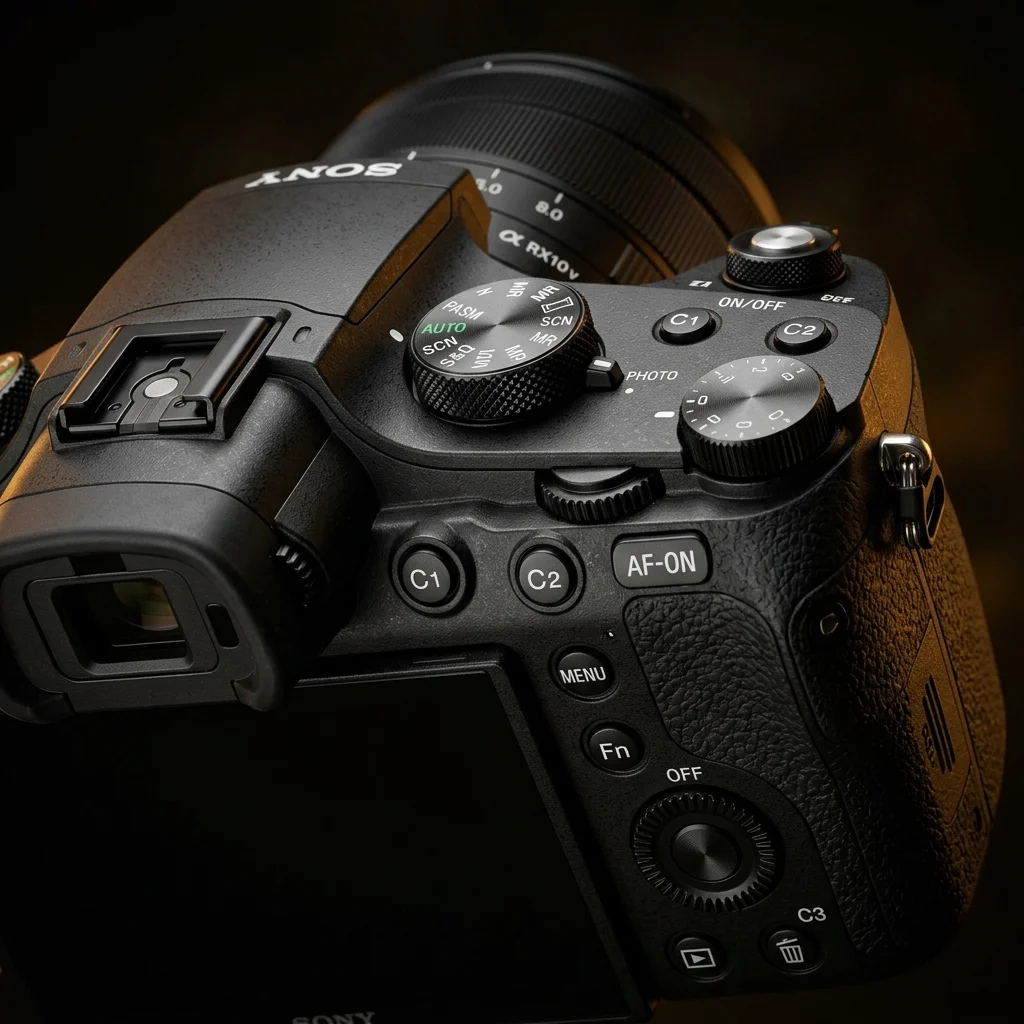
#4Overhauled Ergonomics and Pro-Level Controls
The stodgy, bulbous aesthetic of the RX10 IV has been replaced with a sleeker, more squared-off architecture inspired by the Sony A7 V. The grip is much larger and more comfortable, allowing a secure hold even when pointing the lens at its full 600mm extension.
Physical controls have also been upgraded to match professional cameras:
- A new multi-direction joystick sub-selector for instant focus point positioning.
- Three manual lens control rings (aperture, zoom, focus).
- A dual top dial with a photo, video, and S&Q (Slow & Quick) mode selector.
- An AF-ON button on the rear for back-button focusing.
- Upgraded 3.69-million dot EVF and a bright 1.62-million dot rear display.
The only major downside is the rear display layout. Despite the $2,300 price, the screen only tilts and does not flip out to the side. For vloggers, solo presenters, or selfie content creators, this omission is a notable disappointment.
#5Upgraded Connectivity: 4K Live Streaming & USB-C
The connection array has been modernized. Out goes the micro-USB connector, replaced with a high-speed USB-C (USB 3.2 Gen 2, 10Gbps) port that supports in-camera charging and power delivery during operation. Vloggers and live streamers will also appreciate native 4K 30p live streaming over USB-C without requiring an HDMI capture card.
The camera features a full-sized NP-FZ100 battery (the same one used in the A7 series), extending battery life to approximately 630 shots on a single charge. However, Sony decided to exclude a built-in flash, meaning you will need to slip an external speedlite into the multi-interface shoe if you require fill flash.
Sony RX10 V vs RX10 IV
| Feature | Sony RX10 IV (2017) | Sony RX10 V (2026) |
|---|---|---|
| Processor | BIONZ X | BIONZ XR + AI Unit |
| AF Points | 315 Phase-Detect | 575 Phase-Detect |
| Burst Shooting | 24 fps (With Blackout) | 30 fps (Blackout-Free) |
| Max Video | 4K @ 30p | 4K @ 120p / 10-bit |
| Built-in Flash | Yes | No |
| USB Connection | Micro USB | USB-C (3.2 Gen 2) |
| Battery Life | NP-FW50 (approx 400 shots) | NP-FZ100 (approx 630 shots) |
| Live Streaming | No (Needs software/capture card) | Yes (Native 4K 30p via USB-C) |
TechVantage Verdict
The Sony RX10 V is the ultimate all-in-one camera on the market in 2026. The 24-600mm lens combined with mirrorless-class AI autofocus and outstanding 4K 120p video makes it a force to be reckoned with. While $2,299.99 is a huge price to pay for a 1-inch sensor camera, it represents a monumental saving in both weight and cost compared to buying a full-frame mirrorless system with equivalent zoom lenses.
Stay tuned to our Hardware category for additional reviews, or compare it with other pro setups in our GoPro review.
Frequently Asked Questions
01.What is the price of the Sony RX10 V and when will it ship?
The Sony RX10 V is priced at $2,299.99 (pre-orders are currently open) and is scheduled to begin shipping in August 2026.
02.What are the main video upgrades on the RX10 V compared to the IV?
The RX10 V upgrades video output to 4K 60fps using the full sensor width (no pixel binning, 10-bit 4:2:2 internal) and 4K 120fps with a slight crop. It also supports 1080p at 240fps, S-Log3, custom LUT imports, and upgraded Active Mode image stabilization.
03.Does the Sony RX10 V have a built-in flash?
No. Unlike the older RX10 IV, the new RX10 V lacks a built-in pop-up flash in order to accommodate its redesigned, sleeker top plate and updated EVF housing.
04.How does the autofocus system differ on the Sony RX10 V?
The RX10 V introduces a dedicated AI deep-learning processor that allows subject-recognition tracking for humans (head, eye, body), animals, birds, insects, and vehicles. It also increases the phase-detection AF point count to 575 (from 315) covering 70.6% of the sensor.
05.Does the RX10 V screen flip out for vlogging?
No. The rear 3-0 inch 1.62M-dot LCD screen is a tilting-only display. It does not rotate or flip out to the side, which remains a drawback for vloggers and selfie shooting.