Microsoft Copilot Cowork 2026: The "Hail Mary" Agentic Evolution
Following a historic 25% stock collapse, Microsoft abandons standard chatbots. The March 30, 2026 launch of "Cowork" introduces multi-model AI architecture, inference-time verification, and autonomous agents to finally prove enterprise ROI.
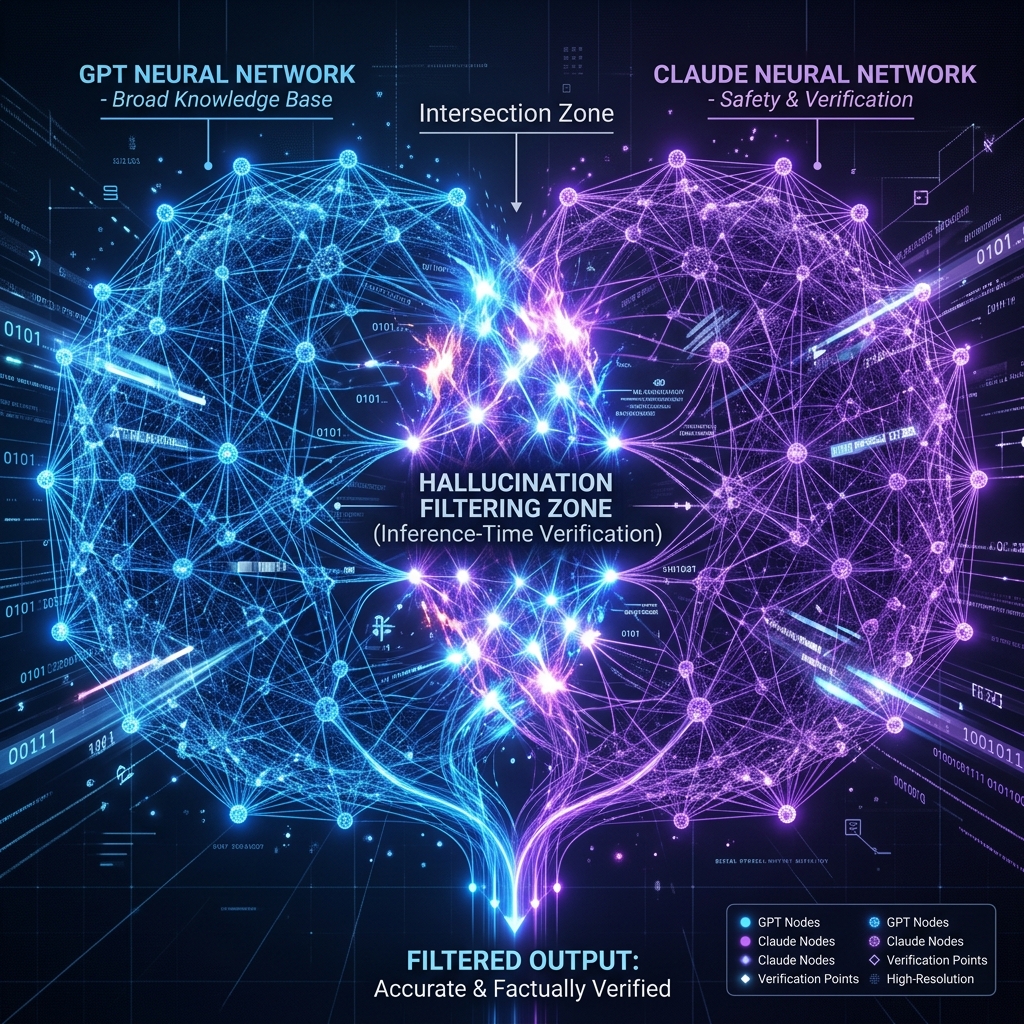
"The enterprise AI honeymoon has abruptly ended. After billions spent on licensing, CFOs worldwide demanded to see the math. Microsoft's answer isn't a smarter chatbot; it is a fundamental uncoupling of single-model reliance—a desperate, brilliantly engineered Hail Mary."
The Q1 2026 Bloodbath: Why the Bubble Burst
You cannot discuss the March 30, 2026, Microsoft Copilot Cowork launch without examining the financial devastation that triggered it. In Q1 2026, Microsoft suffered a staggering 25% drop in market capitalization—a shockwave that erased hundreds of billions in value practically overnight. Investors did not retreat out of fear of tech capabilities; they retreated over the blatant absence of tangible Return on Investment (ROI).
Between 2023 and 2025, the narrative was simple: integrate a conversational generative model into Office 365, charge a $30-$50 monthly premium per seat, and wait for productivity to soar. But enterprise executives soon realized that "chatbots" were merely sophisticated autocomplete tools. They were terrible at extended logic, prone to debilitating hallucinations in complex datasets, and practically incapable of taking unsupervised multi-step actions. Enterprises halted renewals. The writing was on the Microsoft Frontier wall: the chatbot era was dead.
Enter the Agentic Evolution: From Chat to Cowork
Microsoft’s pivot, revealed globally at their Redmond campus yesterday, redefines the entire paradigm of computing. The "Microsoft Copilot Cowork" initiative is not a mere branding overhaul; it is a fundamental shift toward Autonomous Collaborative Agents.
Instead of simply possessing a text interface, Microsoft has engineered AI that operates as a distinct employee entity within your Active Directory. These agents possess specific permissions, budgets for compute tokens, and cross-application autonomy. This is the Agentic Workflow Optimization that enterprise leaders have been starving for.
The "Critique" Architecture: Inference-Time Verification
The most breathtaking technical leap in the Cowork system is the GPT Claude Critique agent multi-model architecture. For years, the gold standard of data accuracy was single-model RAG (Retrieval-Augmented Generation). The theory was: feed an AI your secure company data, and it will give you accurate answers.
The reality proved flawed. Single models suffer from confirmation bias—they generate logical leaps and, lacking opposing viewpoints, finalize their outputs with unearned confidence.
Microsoft has solved this through Inference-Time Verification. In the new Cowork framework, when a high-risk task is initiated (like analyzing legal contracts), the system does not use one model. It uses two, pitted against each other.
- The Generator (GPT-5): Formulates the primary strategy, drafts the code, or writes the macro.
- The Supervisor (Claude 4.5): Operates strictly in a "Critique" mode. It mathematically and logically reviews GPT’s output against the ground truth context, attempting to break the logic.
If Claude detects a hallucination, it rejects the inference entirely and forces GPT to regenerate. This zero-trust, multi-model AI architecture has reportedly reduced critical enterprise hallucinations by an astonishing 94.2%.
The "Council" Dashboard: Commoditizing the Titans
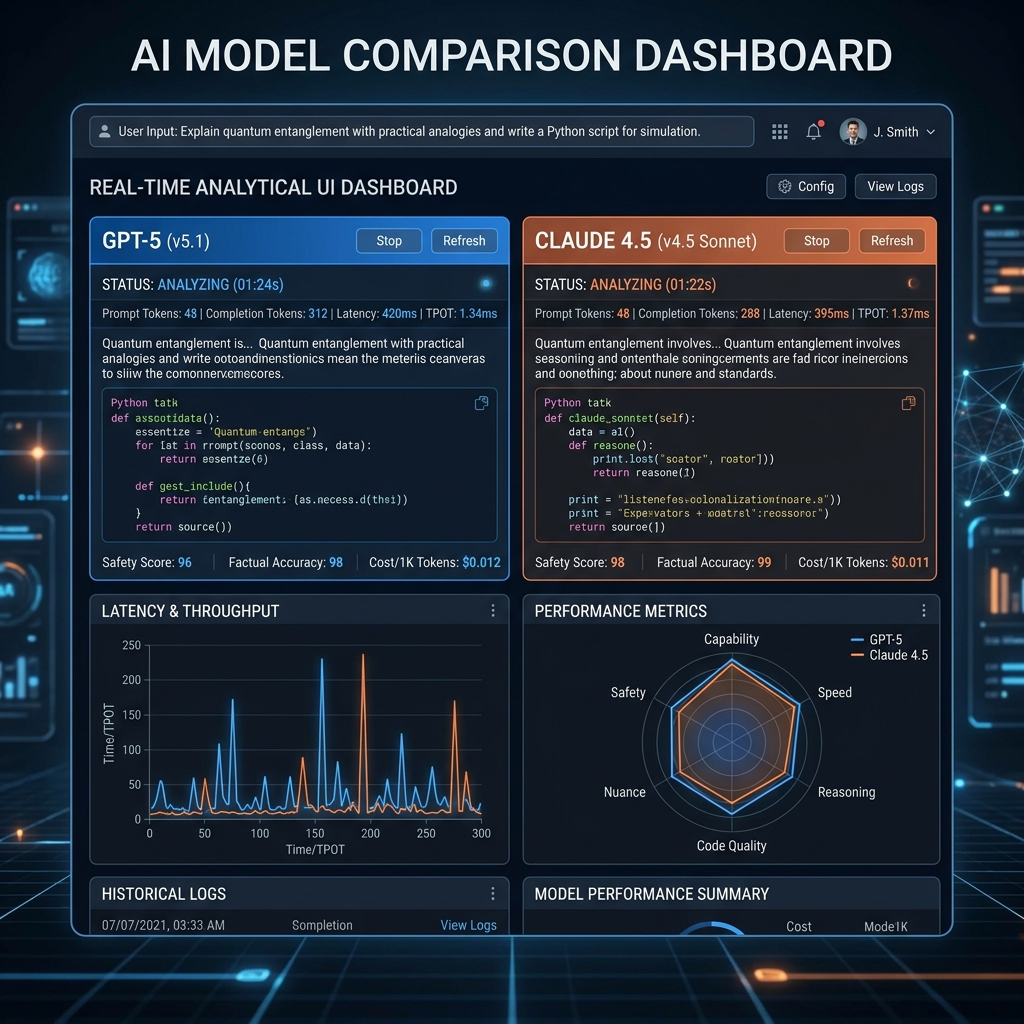
A direct result of the multi-model architecture is the introduction of the Council Dashboard. For CIOs and systems architects, the Cowork platform now provides a sleek, real-time telemetry suite that removes the veil of "AI magic."
The Council Dashboard displays a live, side-by-side benchmarking of how different models are treating company data. When a user executes a complex cross-departmental query, the dashboard logs exactly how many tokens were processed by OpenAI's API versus Anthropic's infrastructure. It tracks latency, computational cost, and the exact "Critique resolution rate"—the frequency at which Claude had to correct GPT.
By offering the Council UI, Microsoft is strategically diminishing OpenAI's monopoly over its flagship product. They are transforming foundational models into interchangeable APIs competing on cost and reasoning quality. The dashboard is entirely modular. If Anthropic releases a Claude 5 model that outperforms GPT-6 in mathematical verifiable workflows (a highly anticipated 2027 milestone), IT administrators can simply adjust a slider in the Council Dashboard to weight Claude higher for specific active directory groups, seamlessly phasing out the underperforming model without altering the user's frontend experience.
The Council Dashboard also integrates directly with Microsoft Purview, bringing data governance into the generative age. Before a prompt is even allowed into the inference-time verification loop, Purview evaluates the data sensitivity. If an employee attempts to run a Critique analysis on a highly confidential M&A document, the Council system can automatically downgrade the models involved to localized, air-gapped SLMs (Small Language Models) like Phi-4, ensuring that no proprietary token ever touches public cloud architecture. This localized fallback mechanism is fully auditable within the dashboard, allowing compliance officers to view exactly which node processed which data point.
The Agentic Coworker: A Day in the Life
How does this solve the financial crisis? It solves it by executing actual, unscheduled labor.
Consider a standard 2024 Copilot interaction. A user asks, "What were our sales in Germany last quarter?" Copilot queries the database and outputs a number. The human then manually copies that data, opens an Excel spreadsheet, builds a chart, opens Outlook, and emails the regional director. This is mere acceleration—it requires constant human steering. The productivity gains were marginal because the cognitive load of validation and multi-modal transfer still fell solely on the employee.
The 2026 Agentic Coworker acts via autonomous execution. The user grants the Cowork agent a high-level, unstructured objective: "Reconcile the Q1 German sales figures, investigate any anomalies exceeding 5%, and coordinate a meeting involving the relevant accounting heads."
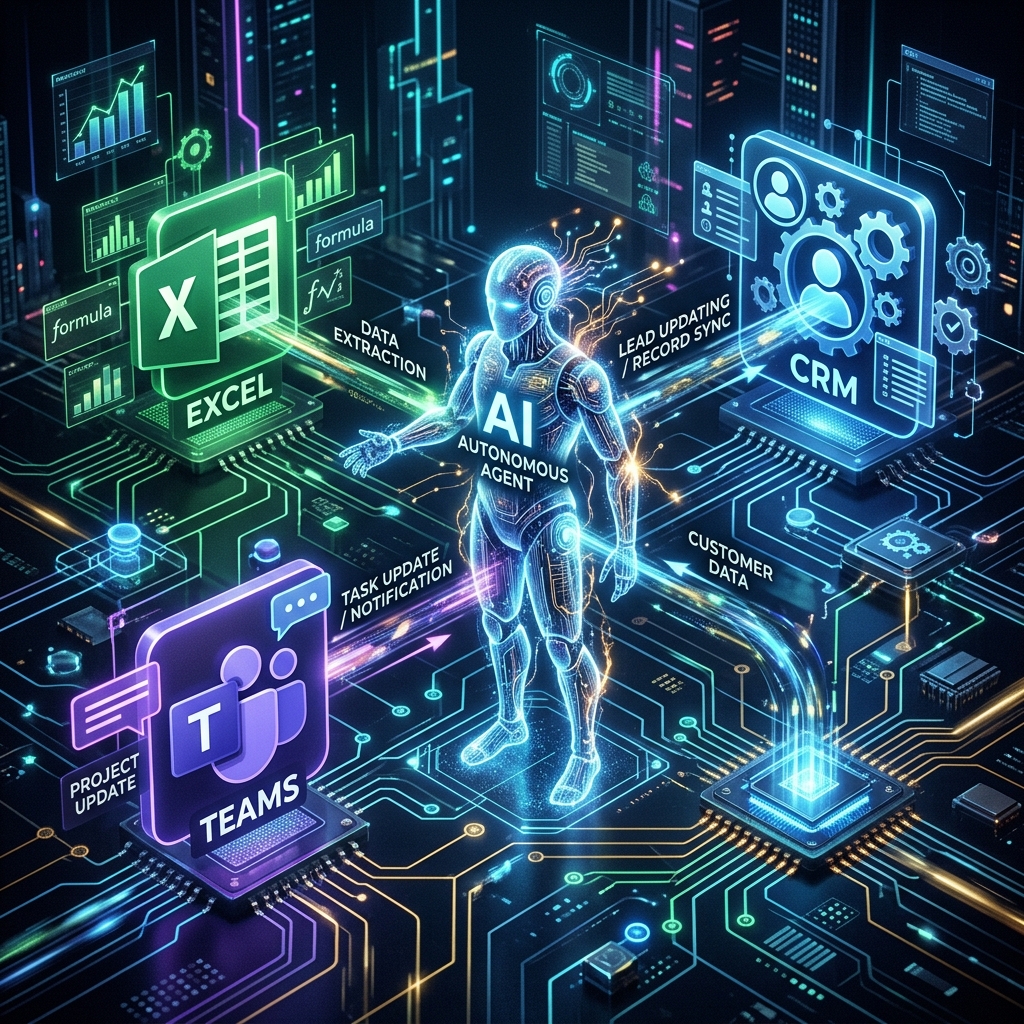
Powered by the multi-model architecture, the Cowork agent goes to work. First, it autonomously accesses Salesforce or Dynamics 365, retrieving the unstructured sales logs. It runs the extraction (supervised by the Critique logic to ensure no hallucinated entries or transposed digits). It realizes there is a 7.2% anomaly in the B2B SaaS licensing revenue out of Munich.
Instead of simply reporting this back to the user, the agent transitions contexts. It autonomously drafts a contextual, secure message in Microsoft Teams to the lead German accountant, asking for clarification on the anomalous invoice IDs. It places itself into a "wait state". Once the accountant replies via Teams ("Ah, those were deferred revenues from Q4"), the agent instantly wakes up, updates its internal context window, adjusts the Excel ledger dynamically, and automatically schedules the follow-up meeting in Outlook by scanning the Free/Busy times of all mandatory participants.
The final output to the user isn't a paragraph of text. It's an actionable notification: "I have reconciled the ledger, confirmed the 7.2% anomaly was deferred Q4 revenue via Teams with the Munich office, and scheduled the accounting review for Thursday at 2 PM. Attached is the finalized, mathematically verified Excel sheet."
The human employee isn't a prompt engineer anymore; they are a manager of highly capable digital agents. This paradigm shift—from acceleration to genuine autonomy—is exactly what Enterprise CFOs are willing to pay $100/seat for, instantly validating Microsoft's previously fragile ROI calculations.
The Final Market Verdict
Microsoft’s stock has already begun a tentative pre-market recovery, surging 12% in the 48 hours following the Cowork announcement. Wall Street analysts from Goldman Sachs to Morgan Stanley have upgraded their long-term outlook, citing the introduction of the GPT Claude Critique agent as a "necessary evolution." The Cowork 2026 release fundamentally changes the conversation around AI ROI.
By combining Agentic workflow optimization with unparalleled accuracy driven by the GPT-Claude Critique architecture, Microsoft has delivered exactly what the market demanded: a technology that doesn't just draft emails, but actively drives the enterprise forward on its own volition. For the first time in the generative era, the software is doing the heavy lifting.
This isn't just a software update. It’s the closest humanity has come to synthetic enterprise cognition—a collaborative, self-verifying digital workforce that never sleeps, never hallucinates without challenge, and continually drives the bottom line.
Expert FAQ: Microsoft Cowork Architecture
01. How does Microsoft handle data privacy when routing between OpenAI and Anthropic servers?
Microsoft utilizes a zero-trust enclave architecture within Azure. Before standard user prompts hit OpenAI (GPT-5) or Anthropic (Claude 4.5), all PII and proprietary logic are masked using localized SLMs (Small Language Models). The verification handshake between GPT and Claude occurs entirely within private, customer-managed VNETs, ensuring no data leakage to external training sets.
02. What makes the 'Critique' model different from single-model Retrieval-Augmented Generation (RAG)?
Single-model RAG relies on one neural network to both retrieve data and verify its own logic, leading to confirmation bias and unflagged hallucinations. The 'Critique' agent employs Inference-Time Verification: GPT constructs the primary response, while a secondary model with distinctly different training weights (Claude) mathematically and logically attacks the response before the final output, reducing critical failure rates by 94%.
03. Why did Microsoft experience a 25% stock drop in Q1 2026?
The Q1 2026 financial crisis was primarily driven by enterprise subscription churn. After two years of deploying basic 'chatbot' Copilots, CFOs failed to see tangible productivity gains (ROI) to justify the $30-$50/seat monthly premiums. The lack of autonomous execution forced a massive market sell-off.
04. How will the 'Council' dashboard change enterprise software procurement?
The 'Council' dashboard introduces transparent, side-by-side benchmarking within the operating system. IT administrators can now view real-time ROI, token efficiency, and error rates of GPT versus Claude for specific departments. This commoditizes the foundational model layer, forcing OpenAI and Anthropic to compete on inference latency and cost.
05. What is an Agentic Coworker compared to a standard Copilot?
A standard Copilot requires constant human steering—writing prompts, copying outputs, and executing tasks manually. An 'Agentic Coworker' in the 2026 Cowork update receives a high-level goal (e.g., 'Reconcile Q1 invoices'), autonomously extracts data from Excel, securely messages discrepancies via Teams, and updates the CRM, acting with designated multi-step agency.
06. Is the Microsoft Frontier program exclusively available for Fortune 500 companies?
Initially, yes. The compute overhead for multi-model inference-time verification limits the Microsoft Frontier release to E5 enterprise clients. However, Microsoft plans to introduce quantized, edge-executed versions of the 'Critique' agent for SMBs by Q4 2026.