KIDS Act Clears House 267–117: What It Means for Kids, Big Tech & Free Speech
The House passed the sweeping bipartisan KIDS Act on June 29, 2026 — overhauling children's online safety rules for the first time in decades. Here's every provision, every criticism, and what happens next.
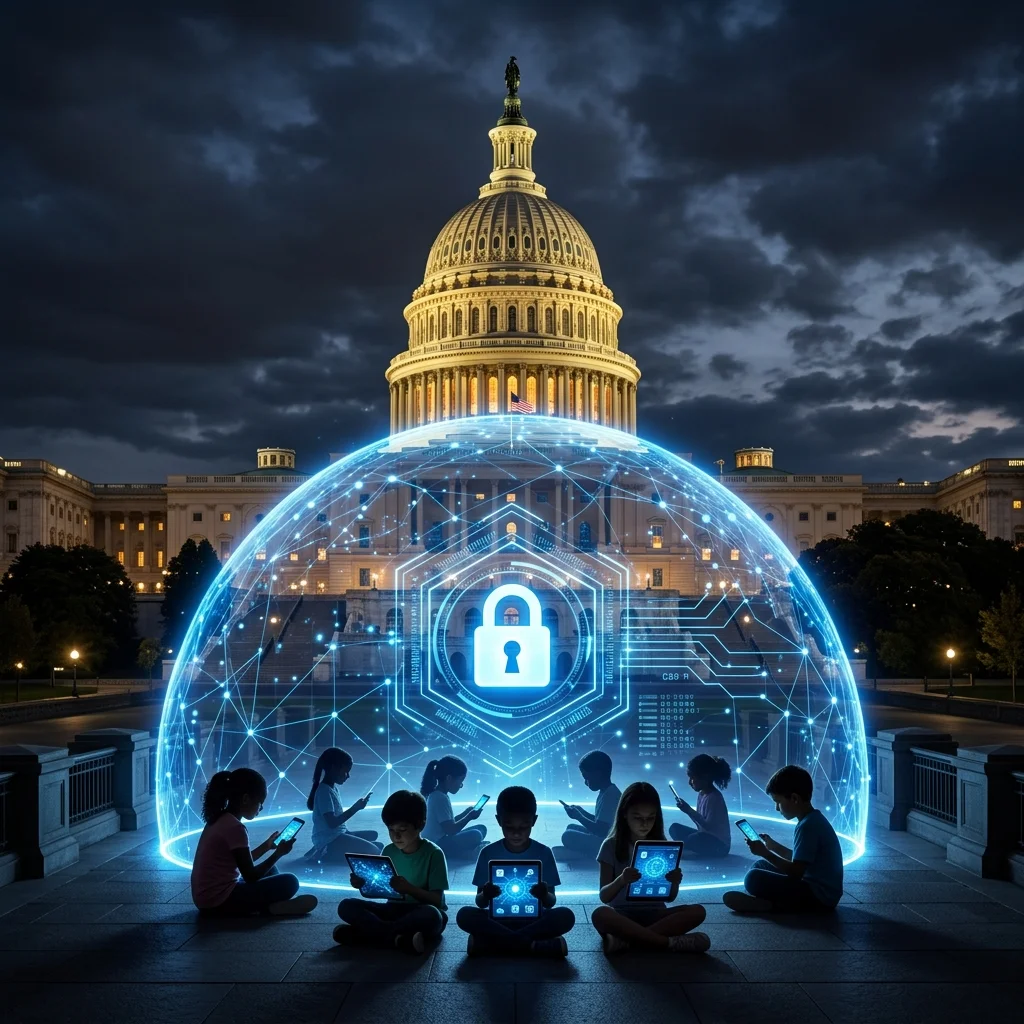
267–117 bipartisan vote. Now heads to the Senate — where significant challenges await.
June 30, 2026 — The U.S. House of Representatives voted 267–117 on June 29 to pass the Kids Internet and Digital Safety (KIDS) Act— one of the most significant attempts to regulate children's online experiences in American history. Supporters call it a landmark child protection law. Critics call it a surveillance bill in disguise. We fact-checked every claim.
Fact-Checked Article
All legislative claims verified against EFF's official analysis, House Energy and Commerce Committee, Tech Policy Press, and IAPP.
267–117
House Vote
~14
Bills Combined
Age 17
COPPA Coverage
Senate
Next Stop
01. What the KIDS Act Actually Does

The Kids Internet and Digital Safety Act (H.R. 7757) is not a single piece of legislation — it consolidates approximately 14 separate digital safety billsinto one comprehensive package. Introduced in March 2026, it combines updated versions of the Kids Online Safety Act (KOSA) and the Children and Teens' Online Privacy Protection Act (COPPA 2.0). Here is exactly what it requires:
👨👩👧 Parental Controls & Safe Defaults
Platforms must implement stronger parental control tools and adopt 'safe by default' settings for minors. Features like autoplay, infinite scroll, and push notifications must be restricted for users under 18.
🔒 COPPA 2.0 — Privacy Up to Age 17
Extends the Children's Online Privacy Protection Act from covering under-13s to covering all users under 18. Platforms must use a "should have known" standard and allow data deletion, correction, and consent control.
📵 No Targeted Ads for Minors
Restricts the use of minors' personal data for behavioral targeted advertising — a major revenue stream for platforms like Meta and TikTok.
🤖 AI Chatbot Regulations
AI chatbots must clearly disclose they are not human, share mental health resources, encourage breaks, avoid simulating emotions to build dependency, and not promote harmful topics to users under 18.
🔞 Age Verification for Adult Content
Pornography websites must implement age verification mechanisms to restrict access for minors. The bill does not specify exact technology but requires platforms to verify age before granting access.
🎮 Online Games & Platform Rules
Establishes new rules governing online games targeting minors, including restrictions on manipulative monetization features, loot boxes, and deceptive design patterns targeting children.
“This is a major step toward a safer online world for kids, making safety the default, giving parents more tools to protect their children and teens, and holding Big Tech accountable.”
— House Energy & Commerce Committee, official post announcing passage, June 29, 2026
📋 Fact-Check: All provisions verified against the official House Energy and Commerce Committee announcement, IAPP legislative summary, and Tech Policy Press. The bill is H.R. 7757, passed June 29, 2026.
02.KIDS Act vs. KOSA: The Crucial “Duty of Care” Gap
To understand the KIDS Act, you need to understand its predecessor. The Kids Online Safety Act (KOSA) passed the Senate in July 2024 by a remarkable 91–3 vote— one of the most bipartisan margins in recent Senate history. But it stalled in the House. The KIDS Act is the House's answer — and it deliberately stripped out the provision many child safety advocates considered KOSA's most powerful tool.
| Provision | Senate KOSA | House KIDS Act |
|---|---|---|
| "Duty of Care" | ✅ Included | ❌ Removed |
| Parental Controls | ✅ Yes | ✅ Yes |
| COPPA 2.0 (Age 17) | ✅ Yes | ✅ Yes |
| Targeted Ads Restricted | ✅ Yes | ✅ Yes |
| AI Chatbot Rules | ⬜ Partial | ✅ Stronger |
| Age Verification (Porn) | ⬜ Separate | ✅ Included |
| State Law Preemption | Broader preemption | Conflict-based (preserves stronger state laws) |
The “duty of care”provision would have legally required platforms to take reasonable steps to prevent foreseeable harms to children — essentially making social media companies liable for mental health damage, bullying, or exploitation that occurs on their platforms. House lawmakers removed it, arguing it was too broad and legally risky. Senate champions of KOSA, including advocates for children's mental health, have called the removal a dealbreaker.
📋 Fact-Check: KOSA's 91–3 Senate passage in July 2024 is documented by official Senate roll call records. The duty of care removal from the House version is confirmed by Pillsbury Law's analysis and The Record.
03.The EFF's Warning: “A Mess” That Threatens All Users

While the bill has strong support from parents and child safety advocates, the Electronic Frontier Foundation (EFF), the leading digital rights organization in the United States, has been one of the bill's most vocal critics. Their concerns cut to the heart of a fundamental tension in digital policy: protecting children without dismantling the open internet.
Joe Mullin, Senior Policy Analyst — Electronic Frontier Foundation
“The package of cobbled-together bills is a mess, with different age-gating schemes for different services, using different standards. It's a lot of complexity, and a lot of legal risk. Faced with that, many companies will conclude that the safest option is restrictive age-checking practices across their entire platforms.”
The EFF's core argument has two prongs. First, the de facto surveillance concern: even though the bill doesn't explicitly mandate age verification, the “known or should have known” liability standard means platforms will implement identity verification to protect themselves legally — and that identity verification will apply to all users, not just minors. Second, the chilling effect on speech: once users must prove their identity to access platforms, anonymous speech becomes much harder. The EFF specifically calls out the impact on users who share sensitive information — including LGBTQ+ youth, domestic violence survivors, and political dissidents — who rely on online anonymity.
✅ Supporters Argue
- • Children are exposed to harmful content at scale on social platforms
- • AI manipulation of children requires regulation
- • Companies must be held accountable for addictive design features targeting kids
- • Parents deserve real tools, not voluntary platform promises
- • Many countries (UK, Australia, EU) have enacted similar laws
❌ Critics Warn
- • Age verification will require government ID — affecting all users, not just kids
- • Anonymous speech will be chilled for vulnerable groups
- • Inconsistent standards create a legal mess companies can't navigate
- • Small platforms and startups will be crushed by compliance costs
- • “Safe by default” mandates could lead to broad content censorship
📋 Fact-Check: Joe Mullin's quote is from an official EFF blog post, documented at EFF.org. The EFF's concerns about anonymous speech and surveillance are also covered by Common Dreams and FIRE (Foundation for Individual Rights and Expression).
04. What Happens Next: The Senate Gauntlet
The KIDS Act now moves to the United States Senate, where it faces a far more complex path than in the House. Senators must reconcile the House-passed package with the Senate's existing preferred framework — and the two chambers are meaningfully far apart.
⚡ Senate Hurdles at a Glance
- Duty of Care gap: Some Senators say the House's removal of this provision guts the bill's most powerful child protection tool.
- KOSA reconciliation: The Senate passed KOSA 91–3 in 2024 — they may insist on restoring its key provisions before signing off.
- EFF and tech industry lobbying: Major tech companies and civil liberties groups are expected to intensify lobbying against certain provisions.
- Age verification fights: The precise mechanism for age verification remains deeply contested — biometric, government ID, or third-party verification?
- Filibuster math: The 60-vote threshold in the Senate makes passage of anything controversial extremely difficult.
For US families, the most practical takeaway right now: this law is not in effect yet. Even if the Senate passes a version of the KIDS Act, the specific requirements for age verification, parental controls, and AI chatbot rules could change significantly before any final legislation is signed into law.
TechVantage Verdict
The 267–117 House vote is a genuine milestone — children's online safety legislation has struggled to advance for years, stalling between chambers with no final law. The KIDS Act's passage signals real political will to act.
But the EFF's warning carries real weight: a poorly designed age-gating system won't just affect children — it will change how every American uses the internet. The Senate phase will determine whether this becomes landmark child protection policy or a surveillance law with a child safety label.
Related Keywords
💡Frequently Asked Questions
What is the KIDS Act?
The Kids Internet and Digital Safety (KIDS) Act (H.R. 7757) is a comprehensive bipartisan package of children's online safety legislation passed by the U.S. House of Representatives on June 29, 2026, by a 267–117 vote. It consolidates roughly 14 separate digital safety bills into one package, covering parental controls, AI chatbot regulations, data privacy for minors, and age verification requirements.
What does the KIDS Act require tech companies to do?
The KIDS Act requires online platforms to implement stronger parental controls and 'safe by default' settings, restrict targeted advertising to users under 18, mandate that AI chatbots disclose they are not human, restrict autoplay and infinite scroll features for minors, and protect the privacy of users up to age 17 (expanding COPPA coverage from age 13 to 17).
Does the KIDS Act require age verification?
The bill does not explicitly mandate age verification, but its 'known or should have known' compliance standard is widely expected to push platforms to implement broad age verification in practice to avoid legal liability. Critics from the Electronic Frontier Foundation argue this effectively forces age-gating across the entire internet.
How does the KIDS Act differ from KOSA (Kids Online Safety Act)?
The KIDS Act is a narrower version of children's safety legislation. Crucially, it dropped the controversial 'duty of care' provision that was included in the Senate-preferred Kids Online Safety Act (KOSA), which would have held platforms liable for foreseeable harms to children. Some senators say the removal of this provision makes the House bill significantly weaker.
What does the Electronic Frontier Foundation (EFF) oppose about the KIDS Act?
The EFF opposes the KIDS Act primarily because it argues the bill creates a surveillance infrastructure by pressuring companies to verify the ages and identities of all users — not just children. The EFF also argues the bill is a 'mess' of inconsistent age-gating standards across different services, creating legal risks that will cause platforms to restrict speech beyond what's legally required.
Will the KIDS Act pass the Senate?
The KIDS Act faces significant challenges in the Senate. Senators must reconcile the House-passed version with the Senate's existing Kids Online Safety Act (KOSA), which passed the Senate 91–3 in July 2024 but stalled in the House. Key points of contention include the removal of the 'duty of care' clause and different approaches to age verification standards.
What is COPPA 2.0 and is it in the KIDS Act?
COPPA 2.0 refers to an updated version of the Children's Online Privacy Protection Act, originally passed in 1998. The KIDS Act incorporates COPPA 2.0 provisions, including expanding privacy protections from children under 13 to teens up to age 17, adding a 'should have known' knowledge standard for platforms, and strengthening data deletion and correction rights.