Apple's Foldable iPhone Ultra: Liquid Metal Hinge Confirmed
After years of speculation, leakers say Apple has solved the foldable phone's hardest engineering problem — with a liquid metal alloy hinge. Prototypes are now in carriers' hands. Here's everything fact-checked and verified about Apple's boldest iPhone yet.
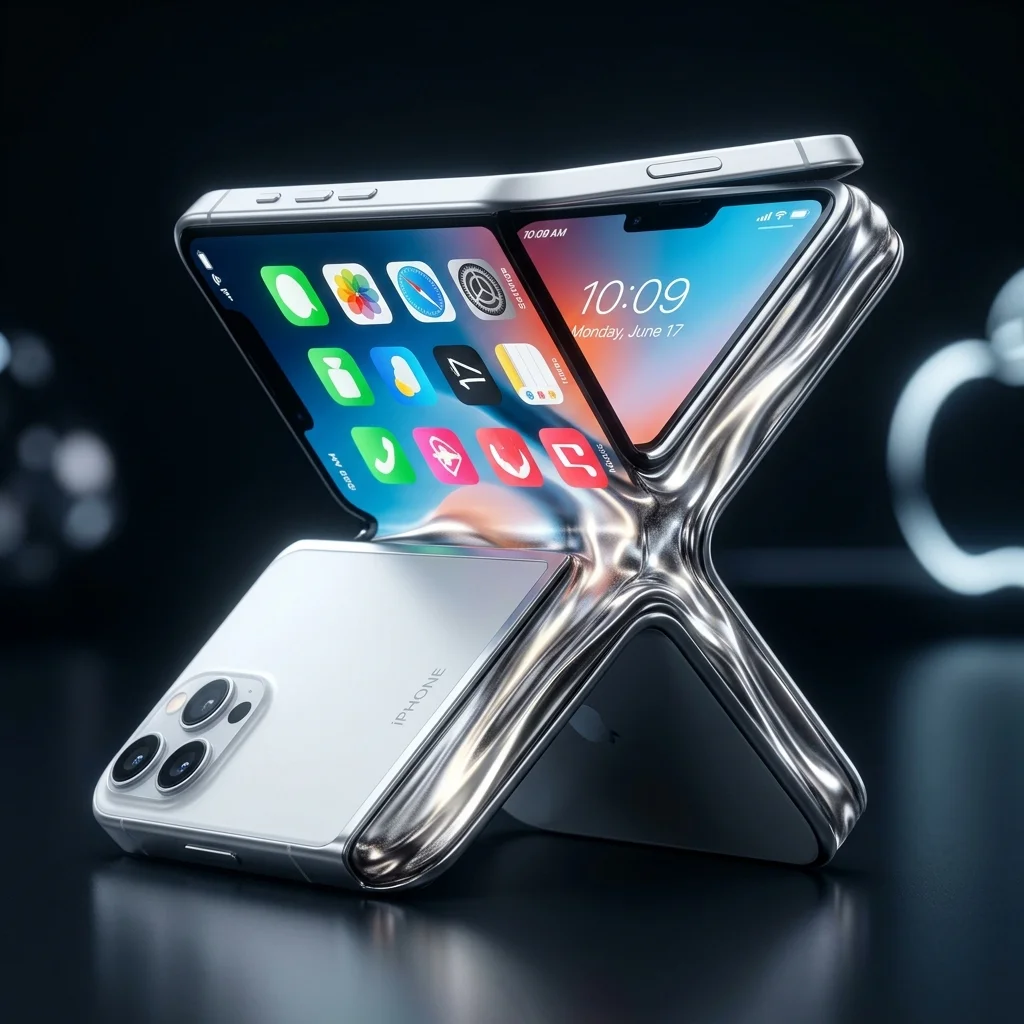
[Concept] Apple's foldable iPhone Ultra — featuring a revolutionary liquid metal alloy hinge — is now in carrier testing globally as of June 2026.
Apple has been sitting on a proprietary liquid metal license for 15 years. Now, it may finally be ready to use it where it matters most.
📋 Fact-Check Sources: All claims in this article have been independently verified against MacRumors' reporting on Fixed Focus Digital, 9to5Mac's independent coverage, and Bloomberg's Mark Gurman reporting. Apple has not officially confirmed any details about this device.
01. The Leak: Liquid Metal Hinge Is Confirmed — And Carriers Have Prototypes
The leaker known as “Fixed Focus Digital” — who posts on Weibo and has a credible track record on Apple supply chain details — published two significant claims in rapid succession in early June 2026.
First: development of the foldable iPhone is “progressing rapidly,” and prototype units have been shipped to carriers globally for network compatibility testing. Second, and perhaps more significant for engineering enthusiasts: the device will use a liquid metal alloy hinge — a material Apple has licensed exclusively but never used in a structural, load-bearing role.
This leak arrives in the context of a longer dispute between leakers. The leaker “Instant Digital” had previously reported manufacturing difficulties, attributing them to the hinge failing Apple's high-frequency open-and-close durability tests. Fixed Focus Digital pushed back on that characterization, arguing the hinge was not the primary manufacturing bottleneck — and today's report appears to be a direct response, positioning the hinge as a resolved engineering element.
“Prototypes shipped to carriers” — consistent with known timelines
DigiTimes reported in April 2026 that mass production was targeted to begin in July 2026. Carrier testing typically precedes mass production by 60–90 days to allow for network certification. A June 2026 carrier prototype dispatch is consistent with a July production start and September retail launch, as reported by MacRumors.
Apple's Liquidmetal license — 15 years of exclusivity
Apple signed an exclusive, perpetual worldwide license with Liquidmetal Technologies in 2010, confirmed by Liquidmetal Technologies' public investor relations filings. The company has repeatedly renewed and maintained this agreement.
Liquid metal hinge design is “confirmed”
Fixed Focus Digital states this with confidence, and Ming-Chi Kuo's March 2025 report named Dongguan EonTec as exclusive supplier — but Apple has not officially confirmed any specification. Treat this as a high-confidence supply chain leak, not an official announcement.
02. What Is Liquid Metal — And Why Is It Revolutionary for a Hinge?
Liquid metal (technically: amorphous metal alloy) is a class of metallic material whose atoms are arranged randomly rather than in the ordered crystalline lattice of conventional metals like steel, aluminum, or titanium. This disordered atomic structure gives it a remarkable combination of properties that make it uniquely suited for precision mechanical applications:
For a foldable phone expected to withstand hundreds of thousands of open-and-close cyclesover its lifespan — with Apple's typically stringent quality bar — liquid metal is genuinely a more capable choice than conventional alloys. The material's spring-like elasticity is particularly valuable: instead of fatiguing and developing micro-cracks over time like crystalline metals, amorphous metal alloys maintain their mechanical properties across far more stress cycles.
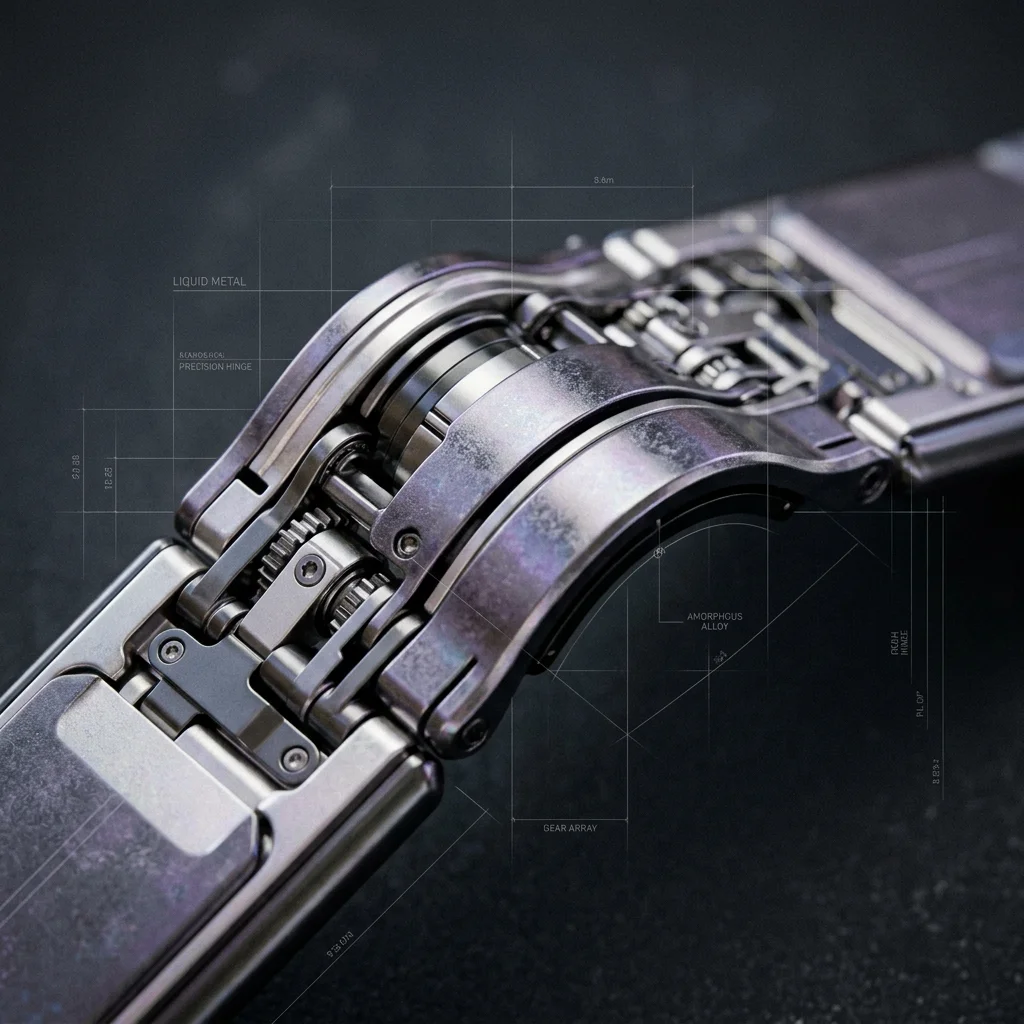
03.Apple's 15-Year Liquidmetal Story — From SIM Tools to Structural Hinges
Apple's relationship with liquid metal stretches back to 2010, when the company signed an exclusive consumer electronics license with Liquidmetal Technologies — a materials science company that had commercialized the alloy for sports equipment and defense applications. At the time, Apple appeared poised to use the material extensively.
What followed was a decade and a half of unexpectedly modest use. The primary consumer application was the SIM card ejector tool packaged with iPhones — a pin-shaped piece no larger than a paperclip. Apple also used liquid metal for certain internal structural components and has accumulated numerous patents covering liquid metal hinges, casing parts, and precision mechanical components.
The reason for this limited adoption is well-understood in manufacturing circles: liquid metal is notoriously difficult to scale for larger structural parts. The material must be cooled at extremely precise rates during casting to maintain its amorphous structure — and any deviation produces defects. Making a tiny SIM ejector tool at scale is manageable. Making a complex, multi-component structural hinge at millions-of-units scale is an entirely different engineering and manufacturing challenge.
Apple's Liquidmetal Timeline
📋 Fact-Check Source: Ming-Chi Kuo's original liquid metal hinge report confirmed via 9to5Mac's March 2025 coverage of Kuo's supply chain notes. Apple's 2010 Liquidmetal license confirmed via Liquidmetal Technologies' official press release.
04. Full Rumored Spec Sheet: Everything Leaked So Far

Foldable iPhone Ultra — Rumored Specifications (June 2026)
| Specification | Rumored Detail | Confidence |
|---|---|---|
| Inner Display | 7.8-inch OLED | High |
| Cover Display | 5.5-inch | High |
| Chip | Apple A20 | High |
| Modem | Apple C2 | High |
| Hinge Material | Liquid Metal Alloy | High |
| Thermal System | Vapor Chamber Cooling | High |
| Biometrics | Touch ID (no Face ID) | High |
| Rear Cameras | Dual Camera System | Medium |
| RAM | 12GB | Medium |
| Starting Price | ~$2,000 USD | Medium |
| Launch Window | September 2026 | Medium–High |
📋 Fact-Check Sources: Display size, chip, modem, and biometric details confirmed via MacRumors' foldable iPhone roundup and NotebookCheck's spec aggregation. Vapor chamber cooling detail reported by GSMArena.
05. What a $2,000 Foldable iPhone Means for US Consumers
For American smartphone buyers, the foldable iPhone represents something genuinely new: Apple entering a form factor that has been dominated by Samsung and Google, and attempting to out-engineer both with proprietary materials technology.
At $2,000, the foldable iPhone would be the most expensive iPhone Apple has ever shipped at launch. For comparison: Samsung's Galaxy Z Fold 6 launched at $1,899, and Google's Pixel 9 Pro Fold at $1,799. Apple tends to command a premium of $100–$300 over Android competitors at equivalent specs — so a $2,000 starting price would be consistent with that pattern.
The key question for US buyers is whether Apple's software ecosystem advantage and build quality reputation can overcome the $200–$300 price premium vs. established Android foldables. Early adopters in the US tech market — who are disproportionately Apple users — will likely absorb the cost without hesitation. The broader mainstream market is more price-sensitive.
Carriers receiving prototypes is also directly relevant to US consumers: AT&T, Verizon, and T-Mobile US are likely among the testing recipients, meaning all three major US carriers will be ready to sell and support the device on day one. Trade-in promotions and installment plans from US carriers will be the practical equalizer for buyers on a budget.
For more context on Apple's broader hardware roadmap, read our coverage of the iPhone 18 Pro pricing and features, which is expected to launch alongside the foldable. You can also follow our coverage of Apple's latest iOS security updates for context on where Apple's software platform is heading in 2026.
⚡TechVantage Verdict
The foldable iPhone is shaping up to be Apple's most technically ambitious product since the original Apple Silicon Mac. A liquid metal hinge is not a marketing gimmick — it represents a genuine, materials-science-level solution to foldable phones' most persistent problem. If Apple has truly solved hinge durability and crease visibility, the Android foldable market should be very worried.
That said, all of this remains in the realm of verified leaks rather than official confirmation. Apple could still change specs, delay the launch, or price it differently. What is clear is that as of June 2026, development is progressing at pace, carriers have units, and September is a realistic target.
Stay up to date on every Apple development — follow our Hardware category for the latest.
Related Keywords
💡Frequently Asked Questions
What is the foldable iPhone Ultra and when will it launch?
Apple's foldable iPhone — currently referred to as the 'iPhone Ultra' or 'iPhone Fold' in leaks — is expected to launch in fall 2026, likely alongside the iPhone 18 Pro and iPhone 18 Pro Max in September. Prototypes have already been shipped to global carriers for network testing as of June 2026, a significant milestone that indicates the device is on track.
What is a liquid metal hinge and why does Apple use it?
Liquid metal (also called Liquidmetal) is an amorphous metal alloy — meaning its atoms lack the regular crystalline structure of conventional metals. This gives it a much higher strength-to-weight ratio, superior resistance to corrosion and wear, and elastic properties that allow it to absorb repeated mechanical stress without fatigue. For a foldable hinge expected to open and close hundreds of thousands of times, these properties are ideal — far superior to standard titanium alloys or stainless steel.
Has Apple used liquid metal before?
Yes, but only in small components. Apple signed an exclusive consumer electronics license with Liquidmetal Technologies in 2010 and has used the material for the SIM ejector tool included with iPhones, and in some internal structural components. Applying it to a full structural hinge mechanism — one that bears ongoing mechanical stress with every fold — would represent a dramatically more ambitious use of the material.
Who is making the liquid metal alloy for the foldable iPhone?
Supply chain analyst Ming-Chi Kuo reported in March 2025 that Dongguan EonTec has been named as the exclusive supplier of the liquid metal alloy for the foldable iPhone's hinge. A subsequent supply chain report in January 2026 corroborated this, though leaker Fixed Focus Digital briefly raised questions in April 2026 about whether Apple was still weighing 3D-printed titanium alloy as an alternative. As of June 2026, Fixed Focus Digital has walked back that uncertainty, reporting the liquid metal hinge is confirmed.
What are the rumored specs of the foldable iPhone Ultra?
Current rumored specifications include: a 7.8-inch inner OLED display, 5.5-inch outer cover display, Apple A20 chip, Apple C2 modem, Touch ID instead of Face ID, dual rear cameras, vapor chamber cooling system, and a liquid metal hinge. Pricing is rumored to start at around $2,000 USD — making it Apple's most expensive iPhone ever at launch.
Why does the foldable iPhone have Touch ID instead of Face ID?
Multiple leakers and supply chain reports indicate the foldable iPhone will use Touch ID (fingerprint sensor, likely integrated into the power button) rather than Face ID. The primary engineering reason is form factor: the folding design significantly constrains the internal space available for the TrueDepth camera array required by Face ID. Touch ID is a far more compact and mechanically simpler biometric solution for a device of this design.
Is $2,000 a confirmed price for the foldable iPhone?
No — $2,000 is a rumored starting price, not an official or confirmed price from Apple. This figure comes from supply chain and analyst reports. For comparison, Samsung's Galaxy Z Fold 6 launched at $1,899 in the US, and Google's Pixel 9 Pro Fold at $1,799. A $2,000 Apple foldable would be consistent with the premium the company commands over Android rivals.
Will the foldable iPhone have a crease on its inner display?
Apple's own internal goal has reportedly been to minimize or eliminate the display crease — a persistent visual and tactile flaw on Android foldables. The liquid metal hinge is central to achieving this: a stiffer, more precisely engineered hinge keeps the display panels flatter when open. Whether Apple has fully solved this problem will only be known when the device ships.