Apple iPhone 18 Pro: Latest Leaks Signal a Major Nano Island Redesign
Multiple credible leakers now point to a dramatically smaller Dynamic Island on the iPhone 18 Pro and Pro Max — and one controversial source has named it the "Nano Island." Here is everything we know, verified and ranked by credibility.
"The Dynamic Island has been the most polarizing design choice since the notch. Now, Apple is reportedly ready to make it so small you'll almost forget it's there — and that changes everything about how Face ID works."
The Core Leak: A Smaller Dynamic Island Is Coming
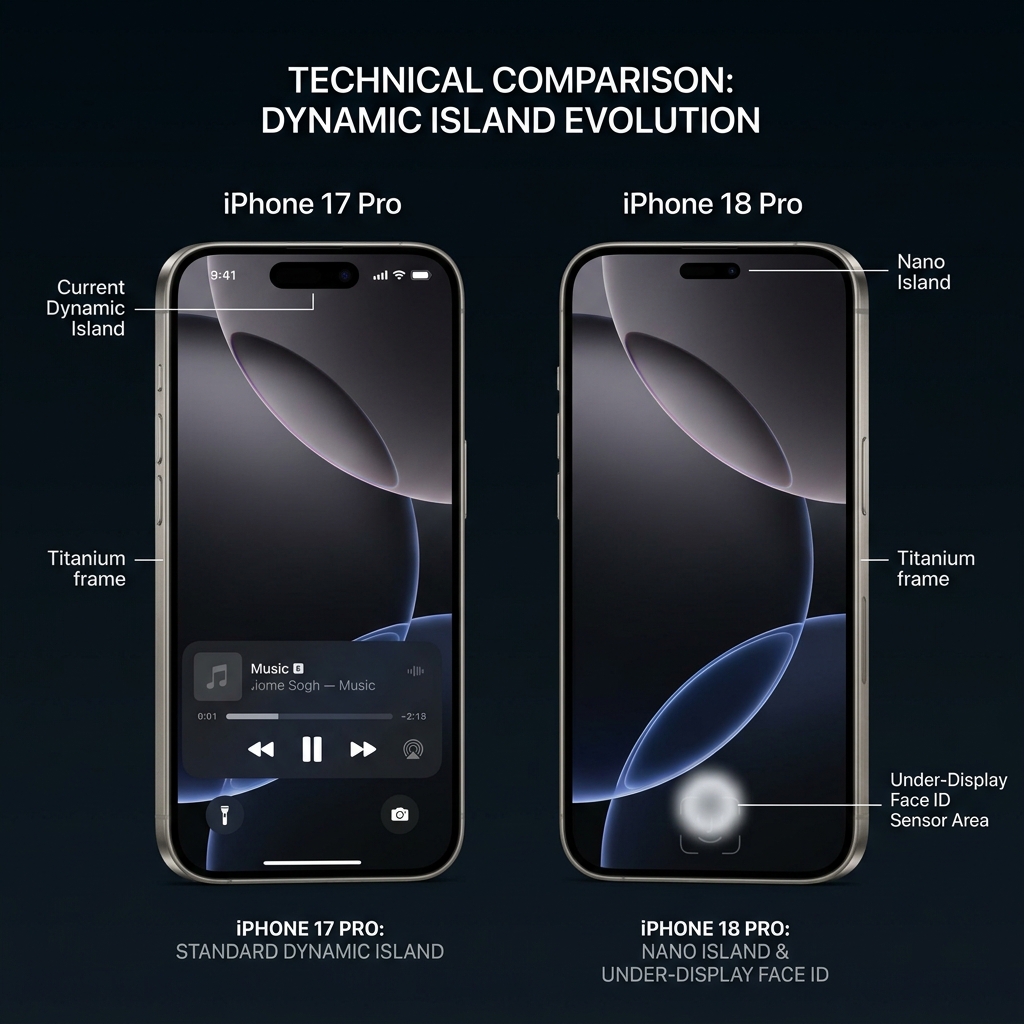
The most significant iPhone hardware report of early 2026 comes from Ice Universe, a well-respected leaker with a verified track record on display specifications. Posted to Weibo in March 2026, the claim is straightforward: the iPhone 18 Pro and iPhone 18 Pro Max will retain the same overall bezel size as the iPhone 17 series, but will feature a significantly narrower Dynamic Island cutout at the top of the display.
The exact quote, machine-translated from Chinese, reads: "The iPhone 18 series retains the same bezel design, except for a smaller central island; the overall bezel size remains the same as the iPhone 17 series." This is a nuanced distinction — Apple is not shrinking the bezels (a change that would require a full redesign of the display panel mounting system), but it is reducing the physical footprint of the sensor cutout that Dynamic Island software wraps around.
For consumers, this means more usable screen real estate right at the top — a prime zone for status indicators and notification content. For Apple's engineering team, it implies a massive internal redesign of how Face ID sensors are packed into the device.
What a Smaller Dynamic Island Actually Requires
To understand why this is a big deal, you need to understand what lives inside the current Dynamic Island cutout. The pill-shaped hole in your iPhone 15, 16, or 17 screen houses the following hardware:
- Dot Projector (Face ID): Projects 30,000+ infrared dots onto your face to create a 3D depth map.
- Infrared Camera: Reads the dot pattern reflected from your face.
- Flood Illuminator: Ensures the IR camera works in dark environments.
- Front TrueDepth Camera: The 12MP selfie camera visible on the left of the island.
Shrinking this cutout meaningfully without degrading Face ID performance is not trivial. Industry analysts have speculated for years that the only way to significantly reduce the island's size is to move some or all of the Face ID hardware under the display. This is exactly what the most viral new leak appears to suggest.
The Viral Leak: Is Face ID Going Under the Screen?
An account on X (formerly Twitter) called Early Apple posted an image that set the enthusiast community on fire. The photo, taken of what is claimed to be an iPhone screen, shows an unusual characteristic: when the photographer's flash fires, a small circular glow appears on the left side of the display, beneath the surface.
The interpretation is compelling: if correct, this circle could be the glow of an under-display infrared emitter— a component of a relocated Face ID system. If Apple has successfully moved the Face ID projector and illuminator beneath the OLED panel, the cutout at the top would only need to house the front-facing camera, making the resulting "island" dramatically smaller.
Ice Universe subsequently weighed in, posting separately on X to confirm their position: "iPhone 18 series bezel are the same as the iPhone 17 and iPhone 16. But all three iPhone 18 reduce the width of Dynamic Island." This convergence — two sources pointing in the same direction independently — adds meaningful, though not conclusive, credibility to the claim.
⚠️ Credibility Check: Ranking the Sources
Ice Universe (Weibo/X)
Highly credible. Established track record for Apple and Samsung display specs. Multiple confirmations. ✅
Early Apple (X)
Newer account, image is intriguing but unverified. Treat with moderate caution. ⚠️
@MajinBuofficia (X) — the "Nano Island" name
Appears to be an unofficial clone account of the established Majin Bu. The "Nano Island" branding claim is unverified. Treat with significant skepticism. ❌
The "Nano Island" Name: Clever Marketing or Misinformation?
The account @MajinBuofficia — which appears to be an unauthorized clone of the legitimate and historically reliable leaker Majin Bu — posted a claim that Apple will market the smaller Dynamic Island under the name "Nano Island." The full post reads: "It seems that Apple has set out to amaze us with its new products this year, despite a delay of several months for the iPhone Fold, everything seems to be taking shape, especially with the new iPhone 18 Pro, Pro Max with the new dynamic island called (NANO ISLAND)!"
We are skeptical. Apple's naming philosophy for Dynamic Island was derived from the feature's core property: it dynamically changessize and displayed content. "Dynamic" is the operative adjective — and it remains accurate regardless of the baseline size of the physical cutout. The name "Nano Island" would imply the island is static and small, contradicting the feature's identity. Apple would almost certainly keep the "Dynamic Island" branding while simply making the underlying hardware aperture smaller.
Until a more credible source confirms the naming, assume "Dynamic Island" will remain the official term.
Impact on the iPhone 18e and iPhone Fold
Two other upcoming Apple products are relevant in this context, and the news for both is nuanced:
iPhone 18e: No Nano Island
The iPhone 18e — Apple's budget-oriented device expected to succeed the iPhone 17e — is almost certainly not getting the Nano Island redesign. The engineering work required to miniaturize Face ID hardware is expensive and complex, and Apple historically reserves its most advanced display technologies for the Pro lineup first. The 18e will likely adopt the standard (current-size) Dynamic Island from the iPhone 17 series, representing a cost-effective upgrade from the 16e's Face ID notch system.
iPhone Fold: Touch ID Makes a Surprise Return
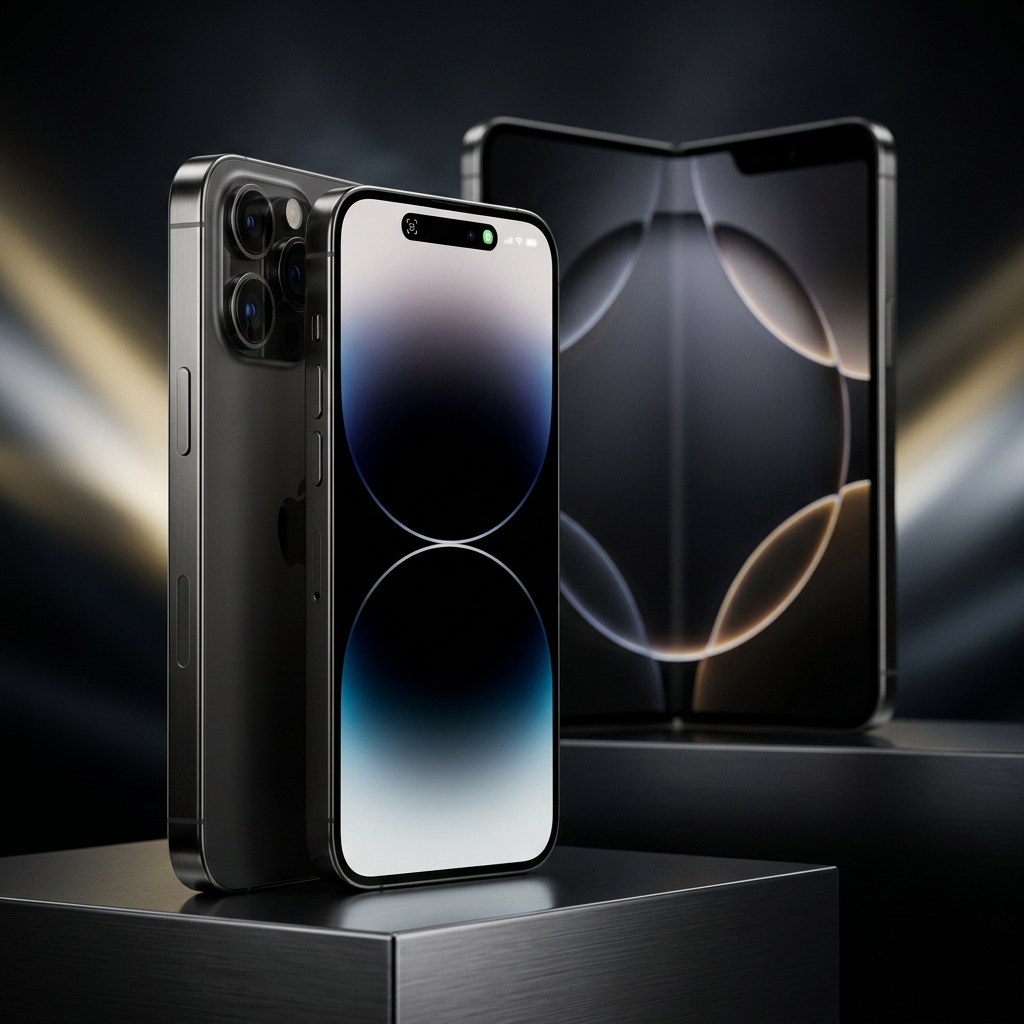
The more dramatic news comes from Bloomberg's Mark Gurman, who reported that the iPhone Fold — Apple's highly anticipated first folding phone — will not feature Face ID at all. Instead, it will revert to Touch ID embedded in the power button.
The reasoning is structural: the Face ID sensor array (dot projector, IR camera, flood illuminator) is thick, and the iPhone Fold must achieve an industry-competitive thin profile when unfolded and an acceptable thickness when folded. Fitting the entire Face ID module into the device's hinge-adjacent bezel is reportedly impossible without compromising on the thinness goals Apple has set.
This is a significant concession for a device that will likely be the most expensive iPhone ever made. Apple has marketed Face ID as vastly superior to Touch ID from a security perspective for nine years. Having it absent from the flagship Fold is a story that Apple will need to tell very carefully.
What This Means for iPhone Buyers in 2026
If the leading leaks are correct — and the corroboration from two separate credible sources suggests they likely are for the Pro lineup — the iPhone 18 Pro will offer the most refined front-facing design in iPhone history. A smaller Dynamic Island means:
- More screen: The top edge is prime real estate for notifications and live activities.
- Cleaner aesthetics: The pill disappears further into the status bar zone visually.
- No battery impact: Under-display IR technology for Face ID consumes similar power to current configurations.
- Backward-compatible software: Dynamic Island's APIs will work exactly the same; the physical footprint simply decreases.
The iPhone 18 Pro remains on track for a September 2026 launch. With Apple's design process typically locked in some 12 months prior to announcement, the physical molds and supply chain for these devices are almost certainly in motion. The Nano Island — or whatever Apple ends up calling the smaller Dynamic Island — is very much real. We will continue tracking every credible source. Bookmark this article for ongoing updates.
For more Apple coverage, read our analysis on how Claude 4.6 and Gemini 3.1 are reshaping the AI landscape powering Apple Intelligence, and our breakdown of the Google Pixel 10a's flat design revolution — the Android rival Apple will be watching very closely.
Expert FAQ: iPhone 18 Pro & Nano Island
01.What is the 'Nano Island' on the iPhone 18 Pro?
'Nano Island' is a leaked internal codename allegedly used by Apple for the dramatically reduced Dynamic Island cutout expected on the iPhone 18 Pro and Pro Max. Unlike the current pill-and-circle Dynamic Island on iPhone 17 series, the Nano Island is reported to be a single, ultra-slim pill that is significantly narrower. The name itself may not be the final marketing term Apple uses — they are far more likely to keep calling it 'Dynamic Island,' just smaller.
02.Is the iPhone 18 Pro getting under-display Face ID?
This has not been officially confirmed, but some leaked images suggest it. One viral image on X appears to show a faint illuminated circle on the left side of an iPhone display after a camera flash — consistent with the positioning of an under-display Face ID sensor. Moving Face ID under the screen would allow the central Dynamic Island to shrink dramatically, since it would no longer need to accommodate the Face ID projector and receiver array.
03.Will the iPhone 18 (standard) also get the Nano Island?
According to Ice Universe, all three models in the iPhone 18 series — including the standard iPhone 18 — will see a reduction in Dynamic Island width. However, the standard iPhone 18 is expected to launch in Spring 2027, much later than the Pro models arriving in September 2026. The iPhone 18e is least likely to get the Nano Island and will probably use the current Dynamic Island design from the iPhone 17 series.
04.Will the iPhone Fold have a Dynamic Island or Nano Island?
The iPhone Fold is expected to skip Face ID entirely, reverting to Touch ID for biometric authentication. Bloomberg's Mark Gurman reported this is because the Face ID sensor hardware is too thick for the thin form factor Apple is targeting for the Fold. Therefore, the Nano Island question is largely irrelevant for the Fold, since there would be no Face ID module to house in a cutout at all.
05.How credible are the Ice Universe and Early Apple leaks?
Ice Universe has a well-established track record, particularly for display specifications on Samsung and Apple devices. Their leaks carry significant weight in the enthusiast community. The Early Apple account on X is newer and less established; while the image they posted is intriguing, it cannot be independently verified. A third account, @MajinBuofficia (note: appears to be an unofficial clone of the established Majin Bu), suggested the 'Nano Island' branding — but this account's authenticity is in question.
06.When will the iPhone 18 Pro officially launch?
Apple is expected to announce and ship the iPhone 18 Pro and iPhone 18 Pro Max in September 2026, following the company's consistent September release cadence. The standard iPhone 18 is reportedly on a different schedule and may not arrive until Spring 2027, which would be a significant departure from Apple's usual simultaneous release strategy.